
Quartz countertops in Northern Virginia are popular for a simple reason: they fit the way many local kitchens are actually used. Weekday breakfasts, school lunches, coffee stations, meal prep, holiday cooking, guests gathering around the island, and the occasional hot pan set down in the wrong place all put a kitchen surface under pressure. A countertop has to look refined, but it also has to survive daily life without becoming another maintenance project.
For homeowners planning a kitchen remodel in Herndon, Chantilly, Reston, Fairfax, Vienna, Ashburn, Sterling, Centreville, McLean, Leesburg, and nearby Northern Virginia communities, quartz is often one of the strongest countertop choices. It offers a consistent appearance, broad color range, strong stain resistance, and lower maintenance than many natural stone surfaces. The key is choosing the right slab style, thickness, edge profile, layout details, sink cutouts, backsplash pairing, and installation plan before fabrication begins.
This guide explains how to choose quartz countertops for a busy Northern Virginia kitchen, what quartz does well, where homeowners still need to be careful, how edge profiles affect the final look, and how quartz should connect with cabinets, backsplash, lighting, flooring, and the rest of the remodel.

Why Quartz Works Well for Busy Northern Virginia Kitchens
Quartz is an engineered surface made from mineral quartz combined with resins and pigments. That manufacturing process gives quartz a more controlled look than many natural stones. Homeowners can select soft white veining, warm greige movement, dramatic marble-look patterns, subtle concrete-inspired tones, or darker surfaces for contrast. Because slabs are produced to a design, the pattern is usually more predictable than granite or quartzite, which can make planning a full kitchen easier.
The biggest everyday advantage is maintenance. Many quartz products do not require sealing, polishing, or routine reconditioning. Cambria’s official product care guidance, for example, notes that its quartz surfaces do not require sealing and can be cleaned with warm water, a soft cloth, and mild soap. MSI’s Q Quartz care guidance also emphasizes warm water and a soft sponge or dishcloth for everyday cleaning, while recommending trivets or hot pads for heat protection. Cosentino’s Silestone maintenance guidance gives stain-specific cleaning advice and reinforces the importance of rinsing and drying surfaces after cleaning.
That combination of style and practical upkeep is why quartz can be a strong fit for households that cook frequently, entertain often, or want a polished kitchen without committing to natural stone sealing schedules.
Quartz vs Granite vs Marble: Quick Comparison
| Surface | Best For | Maintenance | Design Character | Watchouts |
|---|---|---|---|---|
| Quartz | Busy kitchens, family homes, modern remodels, low-maintenance surfaces | Usually no sealing; clean with mild soap and water | Consistent colors, marble-look patterns, subtle or dramatic designs | Use trivets for heat; avoid harsh chemicals and abrasive pads |
| Granite | Homeowners who want natural variation and stone character | Often requires periodic sealing depending on stone and use | Unique natural movement; no two slabs are identical | Pattern variation must be reviewed carefully before fabrication |
| Marble | Classic luxury kitchens, baking zones, statement islands | Higher maintenance; more prone to etching and staining | Soft veining and timeless natural character | Acids, wine, citrus, and daily wear can mark the surface |
If your kitchen is a daily work zone, quartz often gives the best balance of durability, design flexibility, and simple upkeep. Granite may be the right choice when natural variation is the priority. Marble can be beautiful, but it is usually better for homeowners who are comfortable with patina and a higher-maintenance surface.
The Best Quartz Looks for Northern Virginia Kitchen Styles
Northern Virginia homes vary widely: townhomes in Reston and Herndon, colonials in Vienna and Fairfax, newer builds in Ashburn, transitional homes in Chantilly, and larger properties in McLean or Great Falls. A quartz selection should support the architecture of the home, not just the trend of the moment.
Soft White Quartz With Subtle Veining
White quartz with soft gray, beige, or taupe veining is one of the most flexible choices for kitchen remodeling. It brightens rooms, works with painted cabinets, and helps smaller kitchens feel more open. It pairs especially well with shaker cabinets, warm wood flooring, brushed nickel fixtures, and classic subway or handmade-look tile backsplashes.
Warm Neutral Quartz
Warm quartz tones are useful when a home already has oak flooring, beige walls, cream trim, or warm lighting. Instead of using a stark white slab, a warmer quartz can connect the countertop to the rest of the home. This is often a smart direction for traditional and transitional kitchens where the remodel should feel fresh but not disconnected from nearby rooms.
Bold Veined Quartz for Islands
For large islands, a more dramatic veined quartz can create a strong focal point. This works best when the surrounding elements are calmer: simple cabinet doors, restrained hardware, clean backsplash tile, and thoughtful lighting. If both the countertop and backsplash are visually busy, the kitchen can feel crowded even when the layout is spacious.

Durability: What Quartz Handles Well
Quartz is a practical choice for many active kitchens because it is nonporous, highly stain resistant, and more consistent than many natural stones. For daily use, that means coffee, cooking oil, sauces, juice, and normal food prep messes are usually easy to clean when wiped promptly. Quartz is also a good option around undermount sinks because the surrounding surface can be kept clean without grout lines at the countertop level.
Durability does not mean indestructible. Homeowners should still use cutting boards, trivets, and gentle cleaners. Quartz can resist everyday wear, but knives can damage the finish, and sustained heat or sudden thermal change can harm the resin components in engineered quartz. MSI specifically recommends using a trivet or hot pad between Q Quartz and heat-generating items, including hot pots, electric skillets, and similar appliances. That is especially important near edges, seams, and cutouts.
| Daily Situation | Quartz Response | Best Habit |
|---|---|---|
| Coffee, tea, sauces, wine | Generally stain resistant when cleaned promptly | Wipe spills instead of letting them dry overnight |
| Hot pan from the stove | Heat resistant, but not heat proof | Use trivets or hot pads every time |
| Chopping vegetables | Surface is hard, but knives can still mark or dull | Use a cutting board |
| Sticky residue | Usually removable with gentle cleaning | Use mild soap, warm water, and a soft cloth |
| Heavy object impact | Can chip at corners or edges | Choose practical edge profiles in high-traffic kitchens |
Maintenance Plan for Quartz Countertops
One reason homeowners choose quartz countertops in Northern Virginia is that daily care is straightforward. Most kitchens only need a soft cloth or sponge, warm water, and mild dish soap. Harsh chemicals, abrasive pads, drain cleaners, oven cleaners, paint strippers, and aggressive solvents should stay away from quartz surfaces. These products may dull the finish or damage the resin.
A practical quartz care routine looks like this:
| Frequency | Care Step | Why It Matters |
|---|---|---|
| Daily | Wipe crumbs, water, coffee and food residue with mild soap and water | Prevents buildup and keeps the surface looking clean |
| After cooking | Clean oil, spices, tomato sauce, wine, citrus and dark liquids promptly | Reduces the chance of stubborn residue or discoloration |
| During meal prep | Use cutting boards and trivets | Protects finish, edges and cutout areas |
| Weekly | Check high-use areas around the sink, range and coffee station | These zones collect water spots, soap film and residue fastest |
| As needed | Follow the manufacturer’s stain guidance for your specific quartz brand | Different brands may recommend different cleaning products |
Before using any specialty cleaner, check the brand’s care page. Useful starting points include Cambria quartz product care, Silestone maintenance guidance, and MSI Q Quartz care and maintenance.
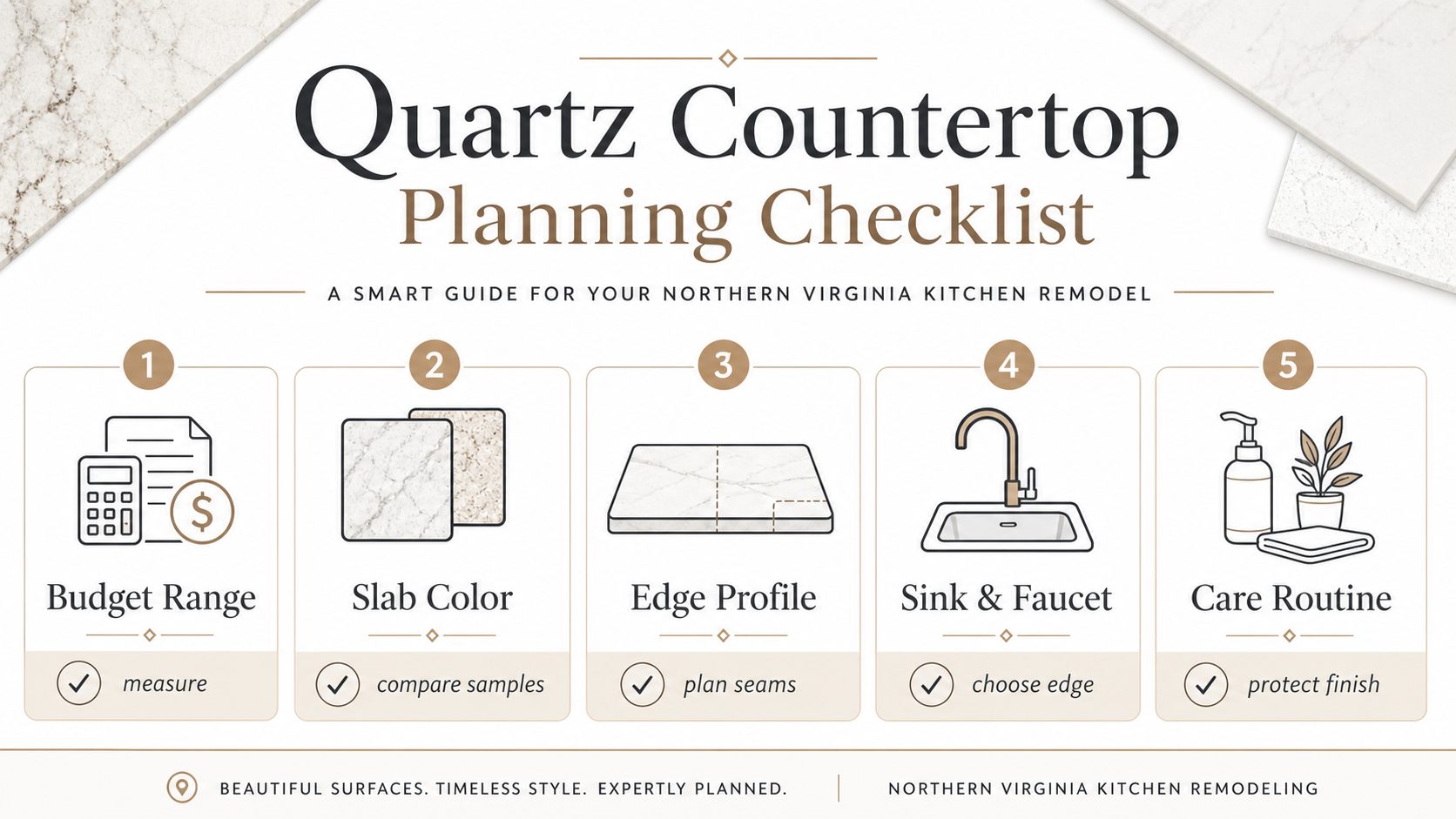
Edge Profiles: Small Detail, Big Visual Impact
The edge profile is one of the most underestimated quartz countertop decisions. It affects style, cleaning, comfort, safety, and the way the countertop relates to cabinet doors. A simple edge can make a kitchen feel cleaner and more contemporary. A more decorative edge can support a traditional cabinet style, but it may also collect more dust and feel busier in a modern kitchen.
| Edge Profile | Style Feel | Good For | Practical Note |
|---|---|---|---|
| Eased edge | Clean and simple | Modern, transitional and busy family kitchens | Easy to live with and rarely feels dated |
| Beveled edge | Slightly tailored | Transitional kitchens, islands, bar areas | Adds definition without becoming too ornate |
| Half bullnose | Softer and rounded | Homes with children, softer traditional designs | Comfortable at seating overhangs |
| Ogee | Decorative and traditional | Formal kitchens and classic cabinetry | Can feel heavy with very busy quartz patterns |
| Waterfall edge | Architectural and modern | Statement islands and open-concept kitchens | Requires careful slab planning and pattern alignment |
For most busy kitchens, an eased or small bevel edge is a smart default. It gives a polished finish without fighting the cabinets, backsplash or flooring. If the island is the centerpiece of the kitchen, a waterfall edge can be beautiful, but it should be planned early because it affects slab quantity, layout and fabrication.
How Quartz Should Coordinate With Cabinets
Quartz countertops should not be selected in isolation. Cabinet color, door style, hardware finish, flooring tone and backsplash all change how a slab looks in the room. A quartz sample that looks crisp in a showroom can feel too cold beside warm floors. A dramatic veined slab that looks exciting by itself can feel too busy next to ornate cabinet doors.
If the kitchen uses white or off-white cabinets, quartz can either continue the light palette or add contrast. For example, a soft white quartz with gray veining creates a bright classic look, while a warm taupe or greige quartz can make white cabinets feel less stark. With navy, charcoal, espresso or natural wood cabinets, a lighter quartz often helps balance the room and keeps the kitchen from feeling visually heavy.
Homeowners replacing cabinets and countertops together should review the cabinet options and countertop products as one design decision. When cabinet boxes, door finish, countertop thickness, appliance panels and hardware are coordinated early, the finished kitchen looks intentional instead of assembled piece by piece.
Backsplash Pairings That Work With Quartz
The backsplash can either support the quartz or compete with it. If the countertop has heavy veining, the backsplash should usually be quieter. If the countertop is subtle, the backsplash can carry more texture, handmade variation or pattern.
Three combinations work especially well in Northern Virginia kitchen remodels:
- Marble-look quartz with simple tile: A clean subway tile, zellige-style tile, or quiet ceramic tile keeps attention on the countertop.
- Solid or subtle quartz with textured backsplash: Handmade-look tile, elongated tile, or stacked tile adds depth without overwhelming the kitchen.
- Quartz backsplash slab: Running the same quartz up the wall creates a seamless, easy-to-clean look behind ranges and sinks.
A full-height quartz backsplash is often more expensive than tile, but it can be very practical behind a cooktop or range because there are no grout joints directly in the splash zone. It also gives a refined, custom look in open kitchens where the countertop and wall surface are seen from nearby living spaces.

Layout Details That Matter Before Fabrication
Quartz countertops are measured, fabricated and installed based on specific field conditions. Once the slab is cut, changes become much harder. That is why countertop planning should happen alongside the full kitchen remodeling plan, not as a last-minute finish selection.
Sink Type and Placement
Undermount sinks are common with quartz because they create a clean transition from countertop to sink. The sink size, reveal preference, faucet hole placement, soap dispenser, air switch, filtered water tap, and garbage disposal switch should all be reviewed before fabrication. A beautiful slab can still be frustrating if the sink zone is crowded or poorly placed.
Seam Placement
Large kitchens may require seams. Good seam planning considers slab size, pattern direction, cabinet breaks, appliance openings, sink cutouts and lighting. Seams should be placed where they make structural and visual sense. With dramatic veined quartz, seam placement becomes even more important because the pattern draws the eye.
Overhangs and Seating
Kitchen islands often need seating overhangs. The overhang depth, support method, stool clearance, aisle width and pendant lighting placement should all be coordinated. A comfortable island is not just about the countertop; it is about how people move around the kitchen while others are seated.
Appliance and Wall Conditions
Ranges, cooktops, refrigerator panels, tall pantry cabinets and uneven walls can all affect countertop fit. In older Northern Virginia homes, walls may not be perfectly square. Professional templating helps account for those conditions so the final installation looks clean.
Quartz Countertops and Kitchen Remodeling Budget
Quartz countertop pricing depends on slab brand, color group, thickness, edge profile, cutouts, backsplash choice, island size, seam planning, demolition, plumbing disconnect/reconnect and installation complexity. A simple perimeter countertop replacement is very different from a full kitchen remodel with new cabinets, waterfall island panels, full-height backsplash and multiple sink or appliance cutouts.
When homeowners compare quotes, they should ask what is included. Does the price include removal of the old countertop? Is sink cutout included? Are faucet holes included? Is there an upcharge for a decorative edge? Are plumbing services separate? Is backsplash part of the scope? These details make a real difference in the final number.
For broader planning, see our guide to kitchen remodeling cost in Virginia and our article on countertop replacement vs full kitchen remodel. If the cabinets are worn, poorly arranged, or not level, replacing the countertop alone may not solve the deeper kitchen issues.
Best Quartz Choices by Kitchen Priority
| Homeowner Priority | Quartz Direction | Design Tip |
|---|---|---|
| Low-maintenance family kitchen | Medium-light quartz with subtle movement | Choose an eased edge and easy backsplash tile |
| Bright resale-friendly remodel | Soft white quartz with gentle gray or beige veining | Pair with classic cabinet colors and simple hardware |
| Statement island | Dramatic marble-look quartz | Keep the perimeter surfaces calmer |
| Warm traditional home | Cream, greige or taupe quartz | Coordinate with flooring and wood tones before ordering |
| Modern kitchen | Concrete-look, solid white, charcoal or waterfall quartz | Use clean lines, slab backsplash or minimal tile |
Common Quartz Countertop Mistakes to Avoid
The first mistake is choosing a slab from a small sample only. Quartz samples are useful, but larger slabs show movement, scale and tone more accurately. If the quartz has bold veining, homeowners should review slab images or full slabs when possible.
The second mistake is ignoring lighting. A quartz color can look different under showroom lighting, daylight, warm under-cabinet lights and evening recessed lights. If the kitchen has limited natural light, a cool gray quartz may feel colder than expected. If the home has warm bulbs and warm floors, a bright white slab may shift visually against those tones.
The third mistake is selecting the countertop before confirming cabinet layout. Cabinet runs, appliance openings, island size, sink position and pantry walls all affect slab quantity and seam planning. Countertop selection should follow a working kitchen layout, not the other way around.
The fourth mistake is using quartz as if it were heat proof. Quartz is durable, but homeowners should still use trivets and hot pads. Slow cookers, air fryers, electric griddles and hot pans can create sustained heat on one area of the countertop. Protecting the surface is a simple habit that helps preserve the finish.
When Quartz Is the Right Choice
Quartz is usually a strong choice when the homeowner wants a refined kitchen surface with predictable design, broad color options and simple maintenance. It is especially useful for kitchens that need to look polished but function hard every day. Parents, frequent cooks, entertainers, and homeowners who want a clean modern finish often appreciate quartz because it does not demand the same maintenance routine as many natural stones.
Quartz may not be the best choice for every situation. If you love unpredictable natural movement, granite or quartzite may feel more authentic. If you want an outdoor kitchen, many quartz products are not recommended for exterior UV exposure, so another material may be better. If you want a surface that naturally develops patina, marble may be more appealing. The right choice depends on how the kitchen will be used, cleaned and viewed over time.
Planning Quartz Countertops With Elegant Kitchen and Bath
Elegant Kitchen and Bath helps Northern Virginia homeowners plan quartz countertops as part of a complete kitchen design, cabinet update, countertop replacement or larger remodeling project. The process should connect the practical details with the design details: cabinet finish, slab selection, edge profile, sink cutout, backsplash, lighting, appliance clearances and installation sequence.
If your kitchen needs a stronger surface, a cleaner layout, a better island, or a more coordinated cabinet and countertop design, start with the full remodeling picture. Explore our countertop products, review our kitchen remodeling services, or visit the Elegant Kitchen and Bath Google Business Profile for location details, photos and reviews.
Quartz Countertop FAQ
Are quartz countertops good for busy kitchens?
Yes. Quartz countertops are a strong option for busy kitchens because they are nonporous, stain resistant and easy to clean with mild soap and water. They still need normal care, including cutting boards and trivets.
Do quartz countertops need to be sealed?
Most quartz countertops do not require sealing. Always check the care instructions for the specific quartz brand selected for your kitchen.
Can you put hot pans on quartz?
It is better to use trivets or hot pads. Quartz is heat resistant, but it is not heat proof. Sustained heat or sudden temperature change can damage the resin in engineered quartz.
What edge profile is best for quartz countertops?
An eased edge or small bevel edge is a practical choice for many busy kitchens. Decorative profiles like ogee can work in traditional kitchens, while waterfall edges are often used for statement islands.
Should quartz be selected before cabinets?
Quartz and cabinets should be selected together, but the cabinet layout needs to be confirmed before countertop fabrication. Sink placement, appliance openings, island size and cabinet runs all affect the countertop plan.