

Quick answer: If your Northern Virginia home was built before 1978, assume painted surfaces may contain lead and plan the remodel around EPA’s Renovation, Repair and Painting (RRP) rule: paid work that disturbs paint must be done by a firm with EPA lead-safe certification, using containment, restricted methods and a cleaning check. Asbestos is a separate question. EPA recommends an inspection by a trained and accredited professional before a remodel disturbs older materials, and advises against sampling them yourself.
Lead and Asbestos Before a Remodel at a Glance
- Lead paint: The federal government banned lead-based paint for homes in 1978, and EPA says about three-quarters of U.S. homes built before 1978 still contain some (EPA).
- Who the RRP rule covers: Anyone paid to disturb paint in pre-1978 housing and child-occupied facilities, including sole proprietors. It generally does not apply to homeowners working on their own home.
- Virginia: Virginia is not on EPA’s list of states authorized to run their own RRP program, so EPA administers the rule here.
- Kitchen and bath work counts: EPA’s examples of paint-disturbing work include removing kitchen cabinets, making cut-outs in walls and HVAC duct work (EPA RRP FAQ).
- Asbestos: Older flooring, insulation, drywall materials and other components may contain asbestos. EPA recommends a trained and accredited professional inspect before a remodel (EPA).
- Virginia permits: The state asbestos inspection certification for permits on pre-1985 buildings does not apply to single-family homes or housing with four or fewer units, unless the work is for commercial or public development (Va. Code § 36-99.7).
Why Does the Age of Your Home Matter Before a Remodel?
The age of the house tells you which materials might be in the walls, ceilings and floors you are about to open. Many Northern Virginia neighborhoods were built before 1978, and kitchens and bathrooms in those homes often have layers of paint on trim, cabinets, walls and ceilings, plus older flooring and insulation behind them. Those materials are generally not a hazard while they are intact. Remodeling changes that: demolition, sanding, cutting and drilling turn paint and building materials into dust.
That is why a remodel in an older home should start with two questions before the design is final. Does the work disturb painted surfaces in a pre-1978 home? And could any of the materials being removed contain asbestos? The answers shape the schedule, the crew, the containment and sometimes the scope. Our older home bathroom remodeling ideas cover the design side; this guide covers the safety rules.
What Does the EPA Lead-Safe (RRP) Rule Require?
The RRP rule is in 40 CFR Part 745, Subpart E (eCFR). It applies to renovations performed for compensation in target housing (most housing built before 1978) and child-occupied facilities. The main requirements for a kitchen or bath remodel:
| Requirement | What the rule says | What you will see on the job |
|---|---|---|
| Firm and renovator | Firms paid to disturb paint in pre-1978 housing must hold EPA lead-safe certification and assign a renovator trained under the rule | Ask for the firm’s certification and the trained renovator’s name |
| Pamphlet before work | No more than 60 days before work begins, the firm gives the owner EPA’s Renovate Right pamphlet and gets a written acknowledgment or proof of mailing (§ 745.84) | You sign a receipt for the pamphlet |
| Interior containment | Ducts in the work area covered, windows and doors closed and covered, floor covered with taped-down plastic 6 feet beyond the work or farther if needed (§ 745.85) | Plastic sheeting, sealed doorways and covered vents |
| Prohibited methods | Open-flame burning of painted surfaces is prohibited; high-speed sanding or grinding only with a shroud and HEPA vacuum attachment; heat guns only below 1,100°F (§ 745.85) | Hand tools, shrouded tools and HEPA vacuums instead of open sanding |
| Cleaning and verification | Specific cleaning, then a cleaning verification by the trained renovator (§ 745.85) | Wipe testing of floors and sills at the end |
| Records | The firm keeps compliance records for 3 years (§ 745.86) | Ask for a copy of the records for your file |
The rule has exceptions. Work that disturbs 6 square feet or less of painted surface per room inside (20 square feet outside) counts as minor repair and maintenance, but only if no prohibited practices are used and the work is not window replacement or demolition of painted surfaces. A kitchen or bath remodel almost always exceeds that. The rule also does not apply where an inspector or risk assessor with EPA or state certification has made a written determination, or a trained renovator has used an EPA-recognized test kit, showing the affected components do not contain lead-based paint at or above the regulated level (§ 745.82).
Does the RRP rule apply if I do the work myself?
In general, no. EPA says the RRP rule does not apply to homeowners doing projects in their own pre-1978 homes, but it does apply if you rent all or part of the home, run a childcare center there, or buy, renovate and sell homes for profit (EPA). EPA still recommends lead-safe work practices for do-it-yourselfers, because the dust is just as hazardous when you create it yourself.
Which Kitchen and Bath Tasks Disturb Paint?
More than people expect. EPA says there is no definitive list, but its examples include (EPA RRP FAQ):
| Remodel task | Why it can disturb paint |
|---|---|
| Removing kitchen cabinets | Cabinets are fastened to painted walls; removal tears paint and drywall paper |
| Making cut-outs in walls | New outlets, vents, pipes or a pass-through cut painted wall surfaces |
| HVAC repair or replacement, including duct work | Registers and duct runs pass through painted ceilings and walls |
| Removing trim, soffits or walls | Painted trim and soffits are removed, demolition creates dust |
| Window replacement | Specifically treated as a covered activity, never minor repair |
| Scraping, sanding or heat-gun paint removal | Directly creates paint chips and dust |
If your kitchen remodel includes taking down a soffit, see our kitchen soffit removal guide. If it includes removing a wall for an open layout, our open-concept kitchen guide covers the structural side.
What About Asbestos in an Older Kitchen or Bath?
Asbestos was used in many building products before its use was restricted, including some flooring, insulation, pipe and furnace insulation and drywall materials. You usually cannot tell by looking whether a material contains asbestos. EPA’s guidance for homeowners is direct (EPA asbestos guidance):
- Leave intact materials alone: If materials are not damaged and will not be disturbed, you do not need to test them.
- Inspect before a remodel: EPA suggests having your home inspected by a trained and accredited asbestos professional if you are planning a remodel, because remodeling can disturb building materials.
- Do not sample it yourself: EPA says taking samples yourself is not recommended, and done incorrectly, sampling can be more hazardous than leaving the material alone.
- Do not sand or cut suspect material: EPA advises against sawing, sanding, scraping or drilling holes in asbestos-containing materials, and against sanding or leveling asbestos flooring or its backing.
- Professional handling: If asbestos is found, repair or removal should be done by professionals trained to handle it.
Does Virginia require an asbestos inspection for a home remodel permit?
Not for most single-family homes. Virginia Code § 36-99.7 says a local building department cannot issue a permit to renovate or demolish a building first permitted before January 1, 1985, until the owner certifies that the affected areas were inspected for asbestos by an inspector holding a Virginia license. But the same section says it does not apply to single-family dwellings or residential housing with four or fewer units, unless the work is for commercial or public development (Va. Code § 36-99.7). So a typical Fairfax or Loudoun homeowner is not required by that section to provide the certification, but EPA’s recommendation to inspect before a remodel still applies. Fairfax County separately lists asbestos removal among the projects that need a permit (Fairfax County).
How Should You Plan a Remodel in a Pre-1978 Home?
| Step | When | What to do |
|---|---|---|
| 1. Confirm the year built | Before design | Check county property records or your deed |
| 2. Decide on testing | Before design is final | Lead testing by an inspector or risk assessor with EPA or state certification, or test-kit results from a trained renovator; asbestos inspection by an accredited professional for materials that will be disturbed |
| 3. Choose the firm | Before signing | Ask for EPA lead-safe firm certification and the trained renovator’s name |
| 4. Plan containment | Before demolition | Agree on which rooms are sealed, how the family uses the house, and where children and pets stay |
| 5. Receive the pamphlet | Within 60 days before work | Sign the Renovate Right acknowledgment |
| 6. Schedule asbestos work first | Before general demolition | If asbestos is confirmed, have it handled before other trades open the area |
| 7. Verify cleaning | End of the work | Cleaning verification done; ask for the records |
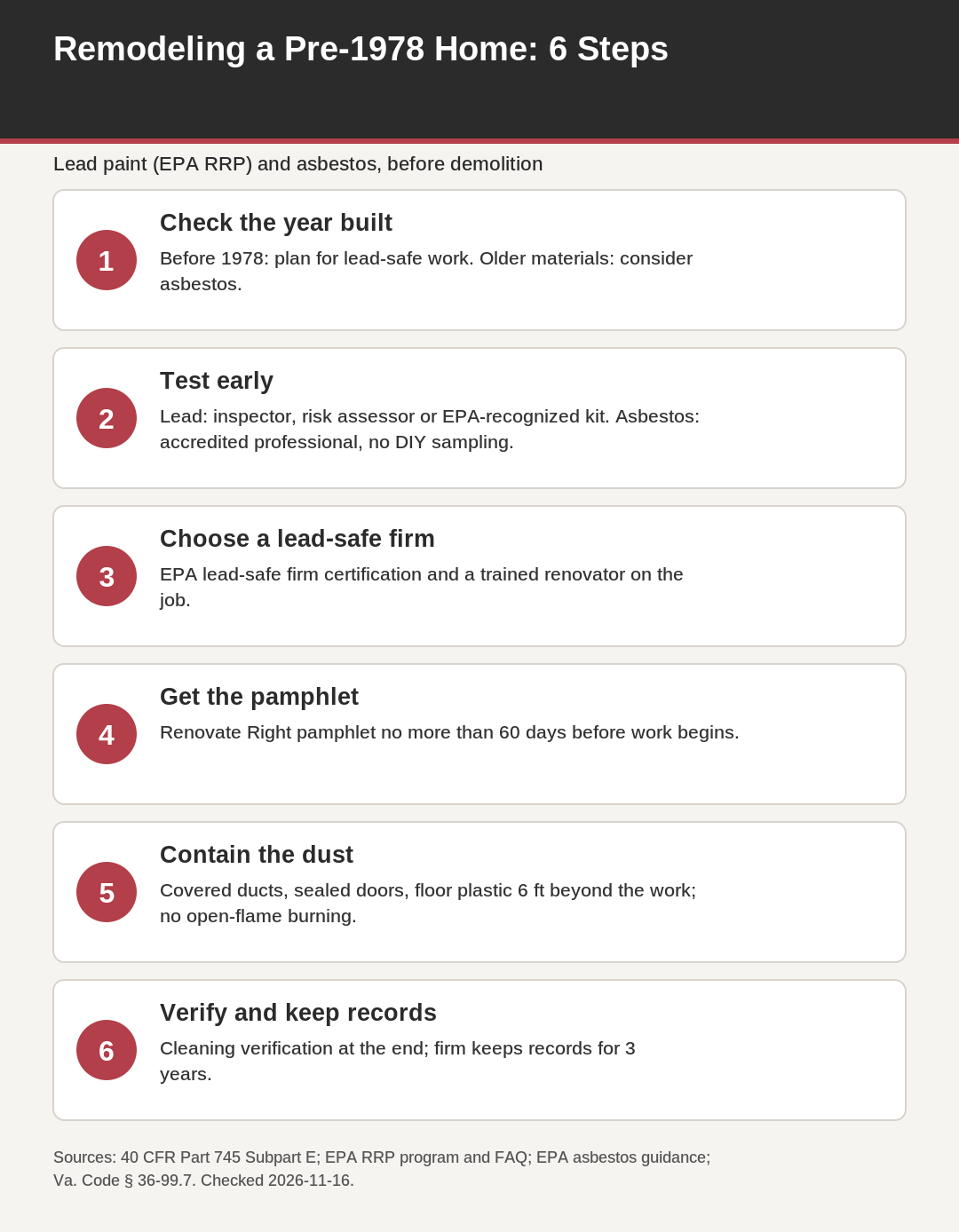
Two planning points save time. First, do the testing early, because results can change the scope, such as covering old flooring instead of removing it, as EPA suggests for asbestos flooring where possible. Second, permits and lead-safe work are separate: a permit from the county does not replace the RRP rule, and the RRP rule does not replace a permit. Our Fairfax County permit guide explains the permit side.
Questions to Ask a Remodeler About an Older Home
- Does your firm hold EPA lead-safe firm certification, and who is the trained renovator on my job?
- Will you test painted components first, or treat them as containing lead?
- How will you contain dust in the kitchen or bathroom, and how will the HVAC system be protected?
- Which tasks in my scope disturb paint, and which methods will you avoid?
- Who handles asbestos inspection and removal if suspect materials are found?
- Will I receive the Renovate Right pamphlet and a copy of the cleaning verification records?
For questions about the federal lead program, the National Lead Information Center is at 1-800-424-5323.
Frequently Asked Questions
Does the lead paint rule apply to my kitchen remodel?
If your home was built before 1978 and you are paying a contractor to do work that disturbs painted surfaces, the EPA RRP rule generally applies. EPA’s examples include removing kitchen cabinets, making cut-outs in walls and duct work. The main exceptions are minor work under 6 square feet of painted surface per room inside, and components shown by an inspector or an EPA-recognized test kit to be below the regulated lead level.
Is Virginia an EPA-authorized state for the RRP rule?
No. EPA lists the states and tribes it has authorized to run their own RRP programs, and Virginia is not among them. That means EPA administers the RRP program in Virginia, and contractors working here follow the federal rule in 40 CFR Part 745, Subpart E. You can report a suspected violation or ask questions through the National Lead Information Center at 1-800-424-5323.
Can I test for lead or asbestos myself?
For lead, home test kits exist, but under the RRP rule a contractor can rely on a test kit result only when a trained renovator uses an EPA-recognized kit; otherwise an inspector or risk assessor with EPA or state certification makes the written determination. For asbestos, EPA says taking samples yourself is not recommended, because sampling done incorrectly can be more hazardous than leaving the material alone. Use a trained and accredited professional.
Do I need an asbestos inspection to get a remodeling permit in Virginia?
For most single-family homes, no. Virginia Code § 36-99.7 requires asbestos inspection certification before a building permit is issued for renovating buildings first permitted before 1985, but it does not apply to single-family dwellings or residential housing with four or fewer units, unless the work is for commercial or public development. EPA still recommends an inspection before a remodel that disturbs older materials.
What does lead-safe containment look like during a kitchen remodel?
Under the RRP rule, the firm covers ducts in the work area, closes and covers windows and doors, and covers the floor with taped-down plastic at least 6 feet beyond the work or farther if needed. Open-flame burning is prohibited, power sanding or grinding needs a shroud and HEPA vacuum, and heat guns must stay below 1,100°F. The job ends with specific cleaning and a cleaning verification.
What happens if asbestos is found during a remodel?
Stop disturbing the material. EPA advises against sawing, sanding, scraping or drilling suspect materials and recommends that repair or removal be done by professionals trained to handle asbestos. Depending on the material, options can include sealing or covering it rather than removing it. In Fairfax County, asbestos removal is listed among the projects that need a permit, so check the county requirements before work resumes.
Plan an Older-Home Remodel the Safe Way
Testing early, choosing a lead-safe firm and planning containment before demolition protect your family and keep the schedule predictable. The rules are federal and state; the planning is local to your house.
To plan a kitchen or bathroom remodel in an older Northern Virginia home, book a design consultation with Elegant Kitchen and Bath or call (703) 763-4277. Our showroom is at 2445 Centreville Rd STE 46, Herndon, VA 20171. You can also see our kitchen remodeling and bathroom remodeling services.