
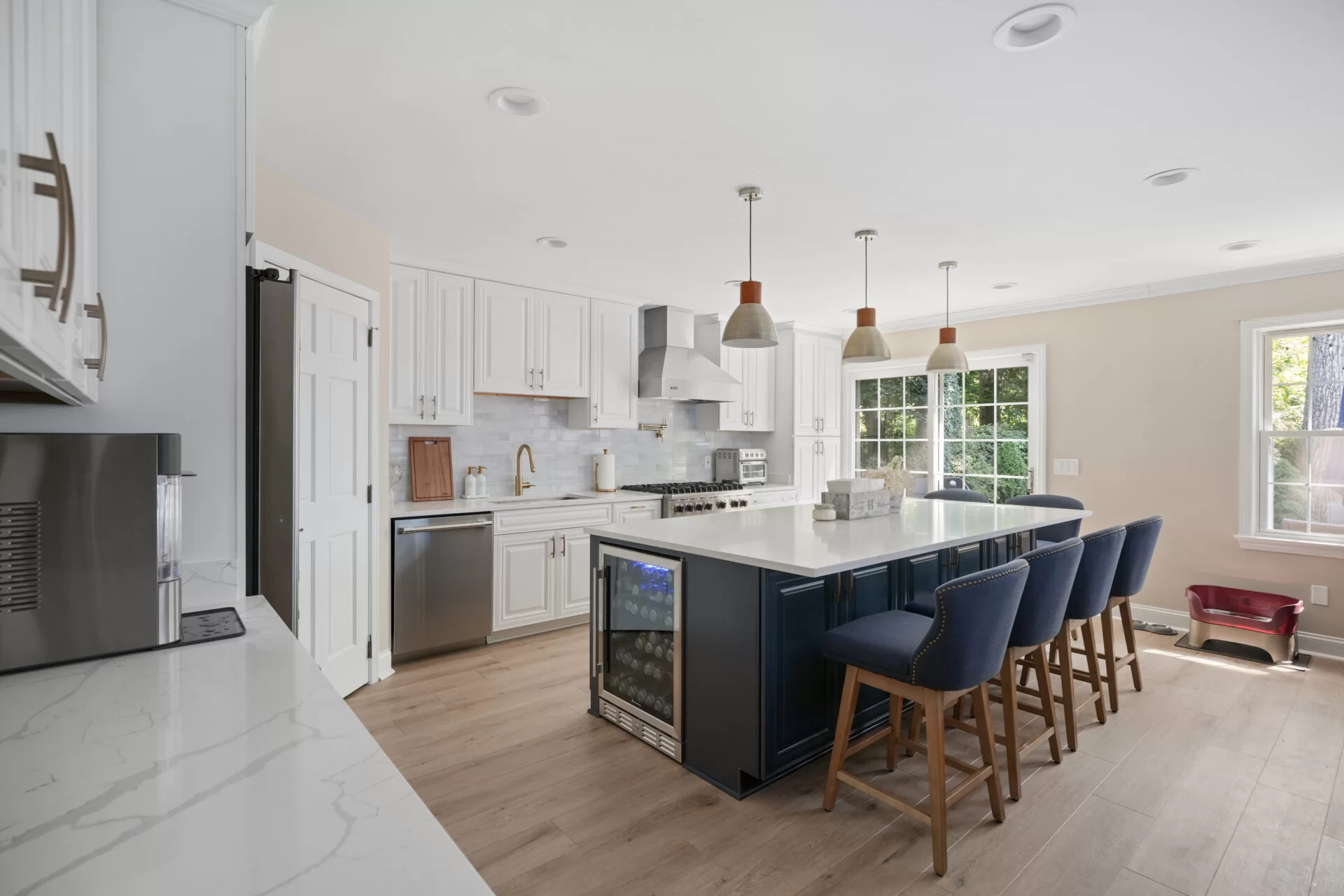
For decades, a gas range was the default in Northern Virginia kitchens. In many subdivisions, builders ran a gas line to the kitchen, and many homeowners grew up cooking over a flame. That is changing. More homeowners who are planning a kitchen remodel in Fairfax, Arlington, Loudoun and the surrounding area now ask whether they should replace the gas range with an induction cooktop or range, and what the switch involves behind the walls.
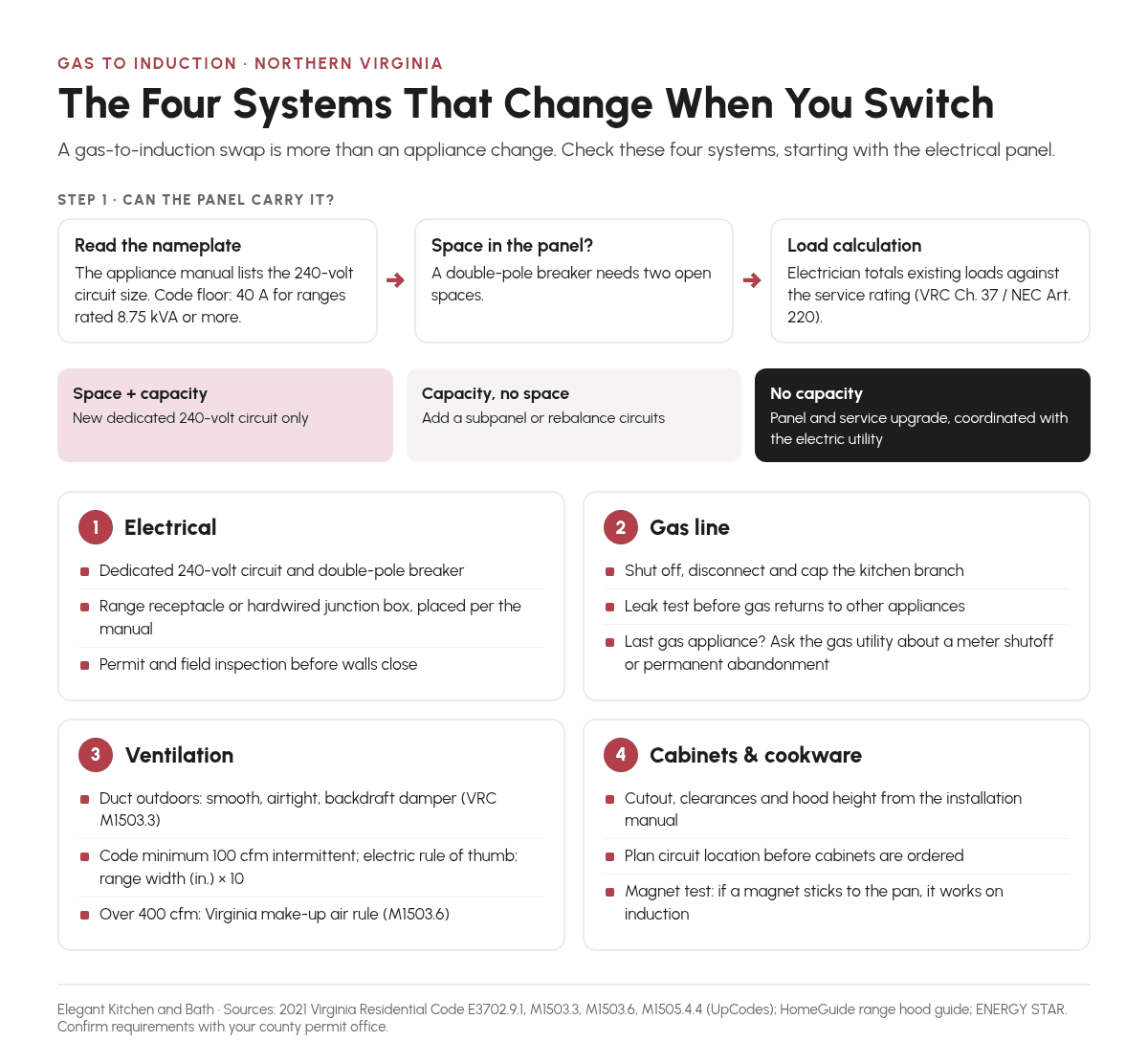
The short version is that swapping a gas range for induction is rarely just an appliance swap. It touches four systems in the house: the electrical panel and wiring, the gas piping, the kitchen ventilation and, often, the cabinetry and countertop around the cooking zone. Each one has its own code rules, permits and costs. This guide walks through all four in the order a homeowner usually meets them. It covers how induction works, which appliance setup fits which kitchen, how to tell whether your panel can carry a new 240-volt circuit, what happens to the gas line, how to size a range hood, when Virginia requires make-up air, which permits apply in Fairfax, Arlington and Loudoun counties, typical national cost ranges, and where Virginia’s appliance rebate program stands in late 2026.
Code references come from the 2021 Virginia Residential Code as published on UpCodes, permit rules link to the county pages that publish them, and cost figures are published national ranges from named sources, dated and labeled as national. They are not quotes for your house.
Quick answer: Switching from gas to induction in a Northern Virginia kitchen usually means adding a dedicated 240-volt circuit sized to the appliance, confirming the electrical panel has capacity, capping the old gas line, and checking that the range hood vents outdoors. Hoods over 400 cfm can trigger Virginia’s make-up air rule. In Fairfax and Arlington, work on gas appliances and new circuits needs permits.
Gas to Induction at a Glance
- Electrical comes first. Most induction ranges and cooktops run on a dedicated 240-volt circuit. The 2021 Virginia Residential Code requires a branch circuit of at least 40 amps for ranges rated 8.75 kVA or more, and the manufacturer’s instructions set the exact size.
- Panel capacity decides the budget. If the panel has room and the service can carry the added load, the electrical work is a new circuit. If not, the project may need a panel or service upgrade, which costs far more.
- The gas line has to be capped properly. Removing a gas range means the supply line is capped and tested. Fairfax County treats gas appliance work as permitted work, and Arlington’s no-permit exemption for appliance swaps excludes appliances fueled by gas or oil.
- You still need a hood. Induction removes combustion byproducts, but cooking still makes grease, moisture and smoke. Virginia’s code requires kitchen exhaust to discharge outdoors through a smooth metal duct, with a listed ductless exception.
- Watch the 400 cfm line. Under Virginia’s version of the code, hoods that exhaust more than 400 cfm need make-up air, with specific exceptions for larger homes without natural-draft appliances.
- Rebates are not live yet. Virginia’s High-Efficiency Appliance Rebate program lists up to $840 for an electric stove, cooktop, range or oven for income-eligible households, but as of October 13, 2026, Virginia Energy says rebates are not yet available and no launch date is set.
Why Are Northern Virginia Homeowners Switching From Gas to Induction?
Gas is still a large part of the region’s housing stock. The U.S. Census Bureau’s American Community Survey does not ask which fuel a household cooks with, but it does ask how homes are heated, and that is a good signal of how many houses have gas service at all. In the 2024 one-year estimates, utility gas was the main heating fuel in roughly 45% to 62% of occupied homes across the five largest Northern Virginia jurisdictions. A house that heats with gas almost always has a gas meter, and many of those houses also have a gas range.
| Jurisdiction | Median year structure built | Occupied homes heated with utility gas | Occupied homes heated with electricity |
|---|---|---|---|
| Arlington County | 1976 | 44.7% (50,739 of 113,562) | 51.4% (58,417) |
| City of Alexandria | 1977 | 46.5% (36,669 of 78,896) | 50.2% (39,588) |
| Fairfax County | 1984 | 53.4% (223,505 of 418,418) | 42.8% (179,201) |
| Prince William County | 1995 | 57.3% (92,348 of 161,034) | 38.5% (61,945) |
| Loudoun County | 2003 | 62.1% (90,833 of 146,170) | 28.9% (42,278) |
Source: U.S. Census Bureau, American Community Survey 2024 1-year estimates, tables B25035 and B25040, via Census Reporter (B25035) and Census Reporter (B25040). Heating fuel is shown because the survey does not ask about cooking fuel; percentages are rounded.
The age column matters too. A kitchen in a 1970s Arlington or Alexandria house often sits on an older, smaller electrical service than a kitchen in a 2000s Loudoun house. That is one of the main reasons the same induction range can be a simple swap in one home and a bigger electrical project in another.
Homeowners give a handful of reasons for making the switch, and most of them come up during a remodel rather than at random:
- Indoor air. The U.S. Environmental Protection Agency lists unvented combustion appliances such as gas stoves among the main indoor sources of nitrogen dioxide, and its guidance on nitrogen dioxide recommends installing and using an exhaust fan vented to the outdoors over gas stoves. Removing the combustion source removes that particular concern, although you still need good ventilation for cooking itself.
- Speed and control. ENERGY STAR notes that induction transfers about 85% of its heat energy to the cookware, compared with about a third for gas, and that induction can boil water in nearly half the time of other cooktop types.
- Cleaning and safety. A flat glass surface with no grates and no open flame is easier to wipe down, and the cooking zone heats the pan rather than the surface around it.
- A remodel is the cheapest time to do it. When cabinets, countertops and drywall are already being replaced, running a new circuit and capping a gas line costs less and disrupts less than doing it later in a finished kitchen.
- Planning for an all-electric house. Some homeowners are replacing a gas furnace or water heater with a heat pump over time and want the kitchen to fit that plan.
None of these reasons makes induction the right choice for every cook. Some homeowners prefer a flame for wok cooking or charring, and some kitchens have electrical limits that make the switch expensive. The rest of this guide is meant to help you see which camp your kitchen falls into before you commit.
How Does Induction Cooking Work, and What Changes in the Kitchen?
An induction cooktop uses a coil under the glass to create a magnetic field. When a pan made of a magnetic metal sits on the zone, the field makes the pan itself heat up. The glass gets warm from contact with the hot pan, but the energy goes into the cookware rather than into a flame or a glowing element. That is why induction responds quickly when you turn it up or down, and why ENERGY STAR describes it as one of the most efficient ways to cook.
According to ENERGY STAR, electric cooking products that earn its label are on average 18% more energy efficient than standard models, and its specification for residential electric cooking products took effect on September 25, 2023. ENERGY STAR’s key product criteria set an annual energy limit for labeled cooktops. If you plan to apply for a Virginia appliance rebate later, the ENERGY STAR label is one of the program’s listed requirements, so it is worth checking for when you choose a model.
Cookware: the magnet test
Induction only works with cookware that a magnet sticks to. Cast iron, enameled cast iron and most stainless-steel pans with a magnetic base work. Plain aluminum, copper and glass do not, unless they have a magnetic layer bonded to the bottom. ENERGY STAR suggests a simple test: if a magnet sticks firmly to the bottom of the pan, it will work on induction. Budget for a few new pieces if your favorite pans fail the test.
What changes in the room
Because there is no flame and no gas connection, induction gives you more freedom in where the cooktop goes. A cooktop in an island no longer needs a gas line run through the floor, only a 240-volt circuit and a ventilation plan. The flat surface also changes the look of the kitchen: a sleek glass cooktop flush with the countertop reads very differently from a pro-style gas range with heavy grates. And a few practical details shift:
- Heat around the cooktop. The cabinets and counter around an induction zone see less radiant heat than around a gas burner, but the pan, oil and steam are just as hot, so clearances in the manufacturer’s instructions still apply.
- Controls. Most induction units use touch controls on the glass. Some homeowners prefer models with knobs, which exist but narrow the choice.
- Noise. Induction units have cooling fans and can hum at high settings. It is worth hearing one in person before you buy.
- Sizes. ENERGY STAR’s labeled electric cooktops and ranges are listed in common residential widths from about 30 to 36 inches, which line up with standard cabinet openings for most gas ranges.
Induction Range, Cooktop or Cooktop With Wall Oven: Which Setup Fits Your Remodel?
The appliance format you choose drives the electrical work, the cabinet layout and the budget. In a kitchen that already has a 30-inch freestanding or slide-in gas range, the simplest path is a 30-inch induction range in the same opening. In a full remodel, many homeowners take the chance to split the cooktop and oven, or to move cooking to an island. The table below compares the main options. Unit prices are national ranges from HomeGuide’s January 2026 stove and oven guide and its appliance installation guide; they are material prices for the appliance only.
| Setup | Typical national unit price | What changes in the kitchen | Fits well when |
|---|---|---|---|
| Induction range (freestanding or slide-in) in the old gas range opening | Induction ranges: $1,000 to $4,000 for the unit (HomeGuide) | One 240-volt circuit at the range location; gas line capped; existing hood often reused if it vents outdoors and is sized for the range | You like your current layout and want the least cabinet and counter work |
| Induction cooktop in the counter plus a separate wall oven | Cooktops: $400 to $1,300; single wall ovens: $1,100 to $2,000 (HomeGuide, all cooktop types) | Usually two circuits (cooktop and oven), a new cutout in the countertop, a tall oven cabinet, and a hood or downdraft for the cooktop | You are replacing cabinets and countertops anyway and want the oven at a comfortable height |
| Induction cooktop in an island | Same as above for the cooktop | Circuit run through the floor or ceiling below, island hood with its own duct route or a downdraft unit, and clearances on all sides | You are opening the kitchen up and want to cook facing the room |
| Pro-style induction range (36 inches or wider) | 36-inch ranges of all fuel types: $1,800 to $4,500; professional ranges: $2,000 to $7,000 (HomeGuide) | A larger circuit per the manufacturer, a wider and often stronger hood, and a check against the 400 cfm make-up air threshold | You cook a lot, want more zones and are replacing a pro-style gas range |
Two points help homeowners decide. First, the existing opening and hood are a strong pull: if both work, keeping the range where it is avoids moving ductwork, which is often the most disruptive part of a kitchen ventilation change. Second, if you are already removing walls for an open-concept kitchen, an island cooktop becomes much easier to plan, because the floor, ceiling and duct routes are open during construction.
Whichever format you pick, download the installation manual before the design is final. It lists the circuit size, the cutout dimensions, the clearance to combustible materials, and the hood mounting height the manufacturer expects. Those numbers feed directly into the electrical plan and the cabinet drawings.
Can Your Electrical Panel Handle an Induction Range?
This is the question that decides most of the budget, so it is worth answering early, ideally before you choose an appliance. A gas range only needs an ordinary 120-volt outlet for its igniter, clock and oven light. An induction range or cooktop needs a dedicated 240-volt circuit with its own double-pole breaker in the panel. Two separate things have to be true for that to work: the panel needs physical space for the new breaker, and the electrical service to the house needs enough capacity for the added load.
What the code requires for the circuit
Virginia adopted the 2021 model codes, including the 2020 National Electrical Code, effective January 18, 2024, according to the Virginia Department of Housing and Community Development. In the Virginia Residential Code chapter on branch circuits and feeders, Section E3702.9.1 says ranges with a rating of 8.75 kVA or more must be supplied by a branch circuit rated at least 40 amperes. The same chapter explains how the branch-circuit load is figured for a single range, and how a counter-mounted cooking unit and up to two wall ovens in the same room can be treated as one range when they share a circuit. In practice, the appliance nameplate and installation manual tell the electrician the circuit size, wire gauge and breaker the unit needs, and the code sets the floor.
Space in the panel versus capacity of the service
Homeowners often look at the panel, see an empty slot or two, and assume the induction range will fit. Space is only half the answer. The other half is a load calculation: the electrician adds up the home’s existing loads (heating and cooling, water heater, dryer, other appliances, general lighting and receptacles) using the methods in Chapter 37 of the Virginia Residential Code, which follow Article 220 of the National Electrical Code, and checks the total against the rating of the service. A house with a 200-amp service and gas heat is more likely to have room for an induction range. A house with a 100-amp service, electric heat, an electric water heater and an electric dryer may not.
Some signs that the panel deserves a closer look before you plan induction:
- The house has a 100-amp or smaller main breaker, which is more common in older homes.
- The panel is full, or already uses many tandem (two-in-one) breakers to squeeze in more circuits.
- You are adding other electric loads in the same remodel, such as a second wall oven, an electric water heater, a heat pump or an electric vehicle charger.
- The panel is an older brand that inspectors and electricians flag. HomeGuide’s panel replacement guide notes that Federal Pacific and Zinsco panels installed from the 1950s through the 1980s should be replaced.
- Breakers trip now when several appliances run together.
Your options if the panel is tight
If the load calculation comes up short, there are usually several paths, and the right one depends on the house:
- Rebalance the existing panel. Sometimes circuits can be consolidated, or a gas appliance that is staying (such as a furnace) leaves enough headroom once the numbers are run carefully.
- Add a subpanel. When the service has capacity but the panel has no space, a subpanel near the kitchen can add breaker positions. HomeGuide lists subpanel installation at $500 to $1,700 nationally.
- Upgrade the panel and service. When the service itself is too small, the panel is replaced and the service is increased, which involves the electric utility. HomeGuide puts a 100-amp to 200-amp panel upgrade at $1,300 to $1,600 and a new 200-amp panel at $1,800 to $2,500 nationally, with a utility meter replacement at $200 to $500 when needed.
- Choose an appliance with a lower rating. Some induction cooktops have smaller ratings than full-size ranges. Comparing nameplate ratings before you buy can keep the project on a smaller circuit.
Any panel or service change is permitted electrical work, and a service upgrade has to be coordinated with your electric utility, which sets its own scheduling and metering steps. Build that coordination into the plan before demolition, not after.
What Does the 240-Volt Circuit and Wiring Work Involve?
Once the panel question is settled, the circuit itself is straightforward on paper: a new cable from a double-pole breaker in the panel to a receptacle or a junction box at the appliance location. The difficulty is the route. In a house where the kitchen sits directly above an unfinished basement, the electrician can often run the cable through open joists in a few hours. In a house with a finished basement, a slab, a second-floor panel or a kitchen far from the panel, the route may go through finished walls and ceilings that then need drywall repair and paint.
HomeGuide’s national pricing gives a sense of scale. Its guide to installing a 240-volt outlet puts the typical cost at $250 to $800, with a national average of $450, and a new dedicated 240-volt circuit at $250 to $900. It lists wire at about $7 to $10 per linear foot for this kind of run, and electrical permit fees of about $30 to $80, while noting that local fees vary. Its appliance installation guide lists drywall repair at $300 to $1,500 or more when walls have to be opened. These are national figures; local labor, access and permit fees in Northern Virginia can move the number in either direction.
Range receptacle or hardwired connection
Most freestanding and slide-in induction ranges plug into a 240-volt range receptacle behind the unit. Many cooktops and wall ovens are hardwired to a junction box in the cabinet below or beside them. The installation manual says which connection the appliance expects, along with the cord or conduit kit it needs. Planning this before the cabinets are ordered avoids a junction box landing behind a drawer that cannot be reached.
Keep a 120-volt outlet if you might go back
Some homeowners like to keep options open for a future buyer who prefers gas. If the old 120-volt outlet behind the range is still useful for other purposes, the electrician can leave it in place, and the capped gas line can be left accessible rather than removed back to the main. Those are design choices worth discussing, not code requirements.
Inspection
New or relocated electrical work in a kitchen is inspected. In Arlington County, the county’s residential permit page notes that electrical compliance is checked by field inspection only, without a separate electrical plan review. In Fairfax County, the county’s permit guidance lists new or relocated electrical work such as outlets, panels and ovens among the projects that need a permit. The inspector will want to see the breaker, the wire size and the connection at the appliance before walls are closed.
What Happens to the Gas Line When You Remove a Gas Range?
A gas range is connected to a branch of the home’s gas piping, usually through a shutoff valve and a flexible connector behind the range. When the range goes, that line has to be made safe. In most kitchens, a plumber or gas fitter shuts off the supply, removes the connector, and caps the line at a point that is either accessible or properly abandoned, then tests the system for leaks before the gas is turned back on for any appliances that remain.
Angi’s national cost guide to capping a gas line, updated September 19, 2026, puts the national average at about $125, with a typical range of $75 to $150, and about $250 if the line is also removed. Angi lists permit costs of roughly $25 to $100 for this kind of work, depending on the jurisdiction.
Permits for gas work
Gas work is where many homeowners are surprised, because a gas appliance swap feels like a small job. Fairfax County’s household appliance permit page explains that the Virginia building code’s exemption for replacing mechanical appliances does not apply to equipment fueled by gas or oil, and that new gas piping is handled under a residential plumbing permit. The county’s “Does my project require a permit?” guidance lists gas work related to stoves and ranges among permitted plumbing and gas projects. In Arlington, the county’s residential permit page says homeowners replacing cabinets, appliances or fixtures in the exact same location can skip permits only when the appliances are not fueled by gas or oil. If your project is in a town such as Vienna or Clifton, Fairfax County notes that the town may have its own approvals as well.
What about the rest of the gas service?
If the furnace, water heater, dryer or fireplace still uses gas, the meter and service stay, and only the kitchen branch is capped. If the range was the last gas appliance in the house, you have a choice to make with the gas utility. Washington Gas, for example, describes two paths on its service abandonment page: customers can call 844-WASHGAS to request a temporary shutoff at the meter, or submit a Service Abandonment/Demolition Request Form to permanently disconnect the service at the property line. Washington Gas says the permanent process generally takes 6 to 14 weeks. If another company supplies your gas, ask it for its own steps before demolition starts.
Fairfax County also points out that fuel-burning appliances may involve a chimney or vent certification. If removing the range is part of a broader change to gas appliances, such as replacing a gas water heater with a heat pump unit, ask the permit office how the venting of any remaining appliances will be reviewed.
Do You Still Need a Range Hood With Induction?
Yes. Induction removes the combustion byproducts that come from burning gas, but it does nothing about what comes off the food. Searing, frying and boiling still release grease, smoke, moisture and odors. Without exhaust, that grease settles on cabinets and ceilings, and the moisture adds to humidity in the house. The kitchen hood is just as important in an induction kitchen; it is simply sized for a different heat source.
What Virginia’s code says about kitchen exhaust
The 2021 Virginia Residential Code chapter on exhaust systems sets the ground rules:
- Discharge outdoors. Section M1503.3 requires domestic cooking exhaust to discharge to the outdoors through a duct that has a smooth interior surface, is airtight, has a backdraft damper and is independent of all other exhaust systems. The duct cannot end in an attic, crawl space or other area inside the building.
- A listed ductless exception. The same section allows listed and labeled ductless (recirculating) range hoods, installed per the manufacturer’s instructions, not to discharge outdoors where the home has ventilation that otherwise meets the code. Recirculating hoods filter grease and some odor, but they do not remove moisture or heat from the house.
- Duct material. Section M1503.4 calls for ducts of galvanized steel, stainless steel or copper, with a narrow exception for downdraft ducts run in PVC under a concrete slab. That rules out the flexible foil duct sometimes found in older kitchens.
- Minimum airflow. Section M1503.5 sends ducted hoods and downdraft fans to the local exhaust table in Section M1505.4.4, which lists a kitchen minimum of 100 cfm for intermittent exhaust or 25 cfm for continuous exhaust. That is a floor, not a target for a busy cook.
How big a hood does an induction kitchen need?
Hood sizing guidance differs by heat source. HomeGuide’s range hood installation guide, updated October 15, 2025, gives a common rule of thumb for electric ranges: multiply the width of the range in inches by 10 to get a starting cfm. That points to about 300 cfm for a 30-inch induction range and about 360 cfm for a 36-inch unit. The same guide notes that most residential hoods are rated between 300 and 700 cfm, and that hoods are usually mounted 24 to 30 inches above the cooktop, depending on the model. The hood’s own installation manual has the final word on mounting height.
A few planning points tend to matter more than raw cfm:
- Capture area. A hood at least as wide as the cooktop, and deep enough to cover the front burners, catches more of the plume than a stronger but narrower fan.
- Duct size and route. A short, straight duct with few elbows lets the fan move close to its rated airflow. Long runs and tight turns cut performance and add noise.
- Wall versus roof exit. HomeGuide lists venting through a wall at $200 to $650 and through the roof at $400 to $900 for a one-story home or $1,000 to $2,000 for a two-story home, all national ranges.
- Island hoods. HomeGuide lists island hood installation at $600 to $1,700 nationally, before ductwork. Island hoods need more capture area because air moves around them from all sides.
- Downdraft units. Some induction cooktops pair with a downdraft vent that rises from the counter. They save the look of an open island but generally capture less than an overhead hood, and they still need a duct route through the cabinets and floor.
When Does Virginia Require Make-Up Air for a Kitchen Hood?
Make-up air is outdoor air brought into the house to replace the air a strong hood pulls out. Without it, a powerful hood in a tight house can struggle to move air, can make doors hard to open, and in homes with natural-draft appliances can pull exhaust gases back down a flue. This is where Virginia’s version of the code differs from the model code in ways that matter for remodels.
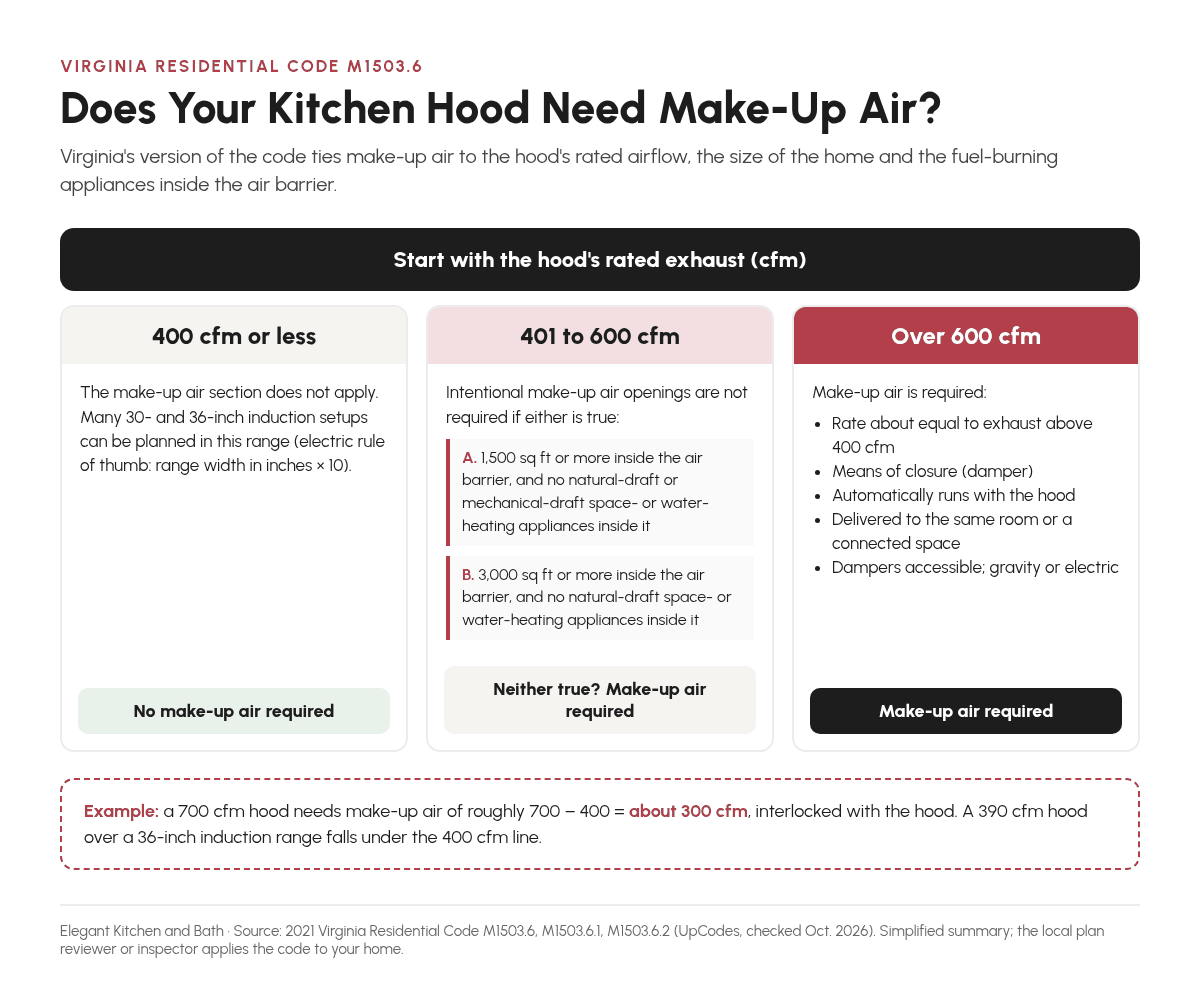
Section M1503.6 of the Virginia Residential Code, as published on UpCodes, says that exhaust hood systems capable of exhausting more than 400 cubic feet per minute must be provided with make-up air at a rate approximately equal to the exhaust air rate in excess of 400 cfm. The make-up air system must have a means of closure and must be automatically controlled to start and operate at the same time as the hood. Section M1503.6.1 says the make-up air must be discharged into the same room as the hood, or into rooms or duct systems connected to that room through permanent openings, and Section M1503.6.2 says the dampers can be gravity or electrically operated and must be accessible.
Virginia’s text then adds an exception that the model code does not have. Intentional make-up air openings are not required for hoods of 600 cfm or less when either of these is true:
- The floor area inside the home’s air barrier is 1,500 square feet or more, and there are no natural-draft or mechanical-draft space-heating or water-heating appliances inside the air barrier; or
- The floor area inside the air barrier is 3,000 square feet or more, and there are no natural-draft space-heating or water-heating appliances inside the air barrier.
For a gas-to-induction project, that creates a useful planning rule. If the hood you choose is rated at 400 cfm or less, the make-up air section does not apply. Between 400 and 600 cfm, the answer depends on the size of the home and on what other fuel-burning appliances remain inside the air barrier. A house that still has an older natural-draft gas water heater in the basement is treated differently from an all-electric house of the same size. Above 600 cfm, make-up air is required.
Arlington County’s residential permit page reflects this in its mechanical plan notes, asking applicants to provide make-up air for kitchen exhaust over 400 cfm and to show the make-up air location. In practice, the inspector or plan reviewer in each jurisdiction applies the code to your specific house, so confirm the hood rating and the make-up air plan during the permit stage rather than after the hood is installed.
Why induction often makes the make-up air question easier
Because induction puts most of its energy into the pan rather than into the room, the hood sizing rule for electric cooking usually points to a lower cfm than a large pro-style gas range would. Many 30-inch and 36-inch induction setups can be planned with a hood at or below 400 cfm, which keeps the make-up air section out of the picture. If you want a stronger hood, for example over a wide induction range in an open kitchen, plan the make-up air path, controls and duct early. It is much easier to run while the kitchen is open than after the new cabinets are in place.
Which Permits Does a Gas-to-Induction Kitchen Remodel Need in Fairfax, Arlington and Loudoun?
Permit rules are set locally under the Virginia Uniform Statewide Building Code, so the details differ between counties, cities and towns. The table below summarizes what the Fairfax County and Arlington County pages say about the work items in a typical gas-to-induction remodel. For Loudoun County, our Loudoun County remodeling permits guide walks through the county’s building and trade permit process. For a deeper look at Fairfax County, see how many permits a Fairfax County kitchen remodel needs.
| Work item | Fairfax County | Arlington County | Notes |
|---|---|---|---|
| Replace a gas range with an electric or induction range in the same spot | Permit: household appliance replacement and gas work are listed as permitted; gas-fueled equipment is not exempt | Permit: the no-permit exemption excludes appliances fueled by gas or oil | The gas side is what triggers the permit |
| New 240-volt circuit or receptacle | Permit: new or relocated electrical work is listed | Not covered by the same-location exemption; electrical compliance is checked by field inspection only | Panel location shown on plans where plans are required |
| Panel replacement or service upgrade | Permit: new or relocated panels are listed | Confirm with Permit Arlington; panel location is shown on plans | Coordinate with the electric utility |
| Cap or remove the gas line | Plumbing/gas permit for gas piping work | Gas work is outside the appliance exemption; confirm the trade permit with Permit Arlington | Leak test before gas is restored to other appliances |
| New range hood or new duct to the outside | Mechanical permit: duct work and range hoods are listed | Mechanical notes cover kitchen exhaust; over 400 cfm, show make-up air | Exterior wall or roof penetrations are part of the review |
| Cabinets and countertops replaced in place | No permit listed for cabinets and countertops | No permit when replaced in the exact same location without relocating pipes or drywall | A permit is usually still needed for the electrical, gas and duct work around them |
| Moving walls, plumbing or the kitchen layout | Interior alteration permit plus trade permits | Interior alteration permit; Asbestos Inspection and Awareness Form for alterations | See our open-concept wall removal guide for structural steps |
Sources: Fairfax County Land Development Services, Does My Project Require a Permit? and Household Appliance; Arlington County, Residential Building Permit. Rules change; confirm with the permit office before work starts.
Fairfax County’s household appliance page describes a single inspection for a straightforward appliance replacement and strongly recommends that a contractor obtain the permits. Fairfax County Land Development Services can be reached at 703-222-0801 for project-specific questions. In the City of Alexandria and in Prince William County, check with the local permit office; the same statewide code applies, but each jurisdiction runs its own permit system.
In a full kitchen remodel, these permits are usually bundled into the project’s overall permit plan rather than pulled one at a time. The electrical, gas and mechanical work is scheduled so that rough-in inspections happen while walls and ceilings are open, and final inspections happen once the appliances and hood are in.
How Much Does It Cost to Switch From Gas to Induction?
There is no single price for a gas-to-induction conversion, because the cost depends on which of the four systems need work in your house. The most useful way to think about it is as a set of building blocks. The table below lists the main ones with published national ranges and the date each source was checked or updated. They are national figures, not Northern Virginia quotes, and they do not include the rest of a kitchen remodel such as cabinets, countertops, flooring or lighting.
| Item | National range | Source (date) |
|---|---|---|
| Induction range, unit only | $1,000 to $4,000 | HomeGuide stove and oven cost (Jan. 2, 2026) |
| Cooktop, unit only (all cooktop types) | $400 to $1,300; installation labor $150 to $370 | HomeGuide appliance installation (Dec. 31, 2025) |
| Range installation labor | $100 to $300 | HomeGuide stove and oven cost (Jan. 2, 2026) |
| New dedicated 240-volt circuit | $250 to $900 (240-volt outlet average $450) | HomeGuide 240-volt outlet (checked Oct. 2026) |
| Electrical permit | About $30 to $80; local fees vary | HomeGuide 240-volt outlet (checked Oct. 2026) |
| Subpanel | $500 to $1,700 | HomeGuide 240-volt outlet (checked Oct. 2026) |
| Panel upgrade, 100 to 200 amps | $1,300 to $1,600; utility meter $200 to $500 if needed | HomeGuide panel replacement (checked Oct. 2026) |
| Cap the gas line | $75 to $150 (average about $125); about $250 with line removal | Angi cap a gas line (Sept. 19, 2026) |
| Replace a range hood | $300 to $850 (average about $575) | HomeGuide range hood installation (Oct. 15, 2025) |
| New hood with outlet and ductwork | $650 to $2,100; ductwork alone $200 to $900 | HomeGuide range hood installation (Oct. 15, 2025) |
| Mechanical permit for a hood | About $100 to $230 | HomeGuide range hood installation (Oct. 15, 2025) |
| Drywall repair after wiring | $300 to $1,500 or more | HomeGuide appliance installation (Dec. 31, 2025) |
Three common scenarios
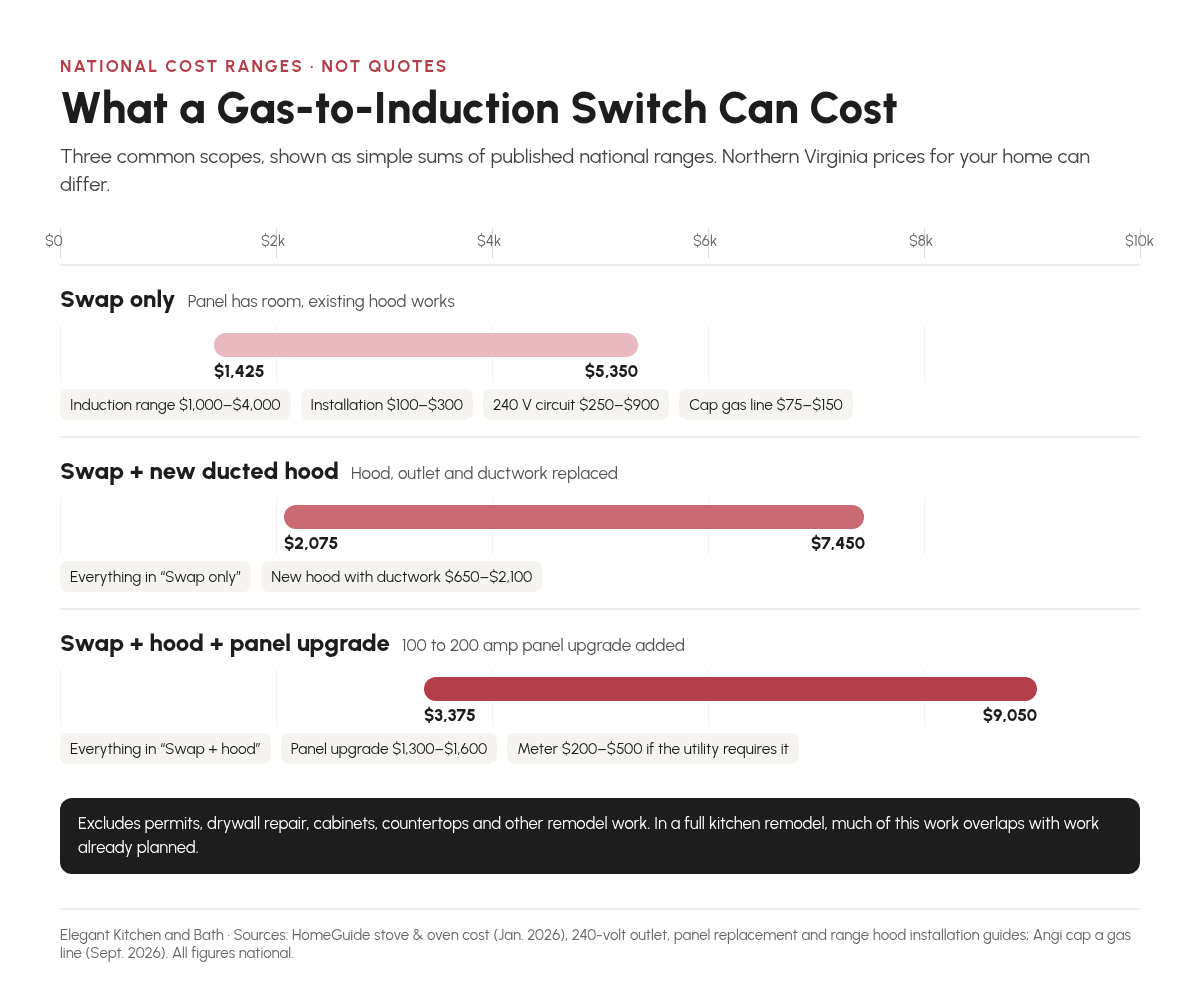
Adding up the national ranges gives a rough sense of how the total moves as the scope grows. These are simple sums of the published ranges above, before permits, drywall repair and finish work, and they are meant for comparison only:
- Swap only, panel has room, existing hood works. Induction range, installation, a new 240-volt circuit and a capped gas line: roughly $1,425 to $5,350 nationally.
- Swap plus a new ducted hood. The same work plus a new hood with ductwork: roughly $2,075 to $7,450 nationally.
- Swap, new hood and a 100-to-200-amp panel upgrade. Roughly $3,375 to $9,050 nationally, plus a meter replacement if the utility requires one.
Inside a full kitchen remodel, much of this cost blends into work that is happening anyway. The walls are already open for new cabinets, the electrician is already on site for lighting and receptacles, and the hood is already being replaced. That is why many homeowners make the switch as part of a remodel rather than on its own. For a fuller picture of kitchen budgets in the region, see our Northern Virginia kitchen remodeling cost guide for 2026, and if you are weighing how to pay for a project, our guide to financing a home remodel in Northern Virginia covers common options.
Thinking about induction for your next kitchen?
Elegant Kitchen and Bath can look at your panel, gas line, hood duct route and layout during a design consultation and show you how an induction setup fits your remodel. Book a design consultation.
Are There Rebates for Induction Stoves in Virginia in 2026?
Not yet. Virginia is preparing two federally funded Home Energy Rebate programs, and one of them covers induction cooking. According to Virginia Energy’s Home Energy Rebates FAQ, last updated October 13, 2026, the High-Efficiency Appliance Rebate program (HEAR) is designed to provide up to $14,000 per household in upfront rebates for qualifying electric appliances and upgrades. The caps set in the Inflation Reduction Act include:
- Up to $840 for an ENERGY STAR electric stove, cooktop, range or oven, shared with the heat pump clothes dryer category under a combined $840 limit per dwelling unit.
- Up to $4,000 for an electrical load service center upgrade, which is the program’s term for panel and service work.
- Up to $2,500 for electric wiring.
- Up to $1,600 for insulation, air sealing and ventilation.
Eligibility is limited by income. Virginia Energy notes that the law restricts HEAR to households earning up to 150% of the area median income, and ENERGY STAR’s HEAR program overview explains that households under 80% of area median income can receive up to 100% of eligible costs, while households from 80% to 150% can receive up to 50%, within the caps.
The timing is the key caveat. Virginia Energy says the rebates are not available now, that it cannot give an estimated launch date, and that it submitted updated application materials to the U.S. Department of Energy in September 2026. It also says HEAR rebates cannot be paid retroactively under the federal law, that projects must be completed by a program-verified contractor whose list has not yet been established, and that the Department of Energy recommends waiting for launch before starting a project that you want rebated. In other words, if the rebate is central to your budget, do not start the kitchen until the program is open and you have confirmed eligibility. For incentives that are available today, Virginia Energy points residents to Virginia Energy Connect.
How Do You Plan a Gas-to-Induction Switch Inside a Kitchen Remodel?
The switch goes most smoothly when it is planned as part of the kitchen design, not added at the end. Here is how the decisions line up with the steps of a typical remodel at Elegant Kitchen and Bath, as described on our remodeling process page:
- Consultation. Talk through how you cook, what you like and dislike about gas, which appliance format you are drawn to, and whether other gas appliances in the house are staying.
- Designer visit and measurements. The designer measures the kitchen and notes the panel’s main breaker size and open breaker spaces, the location of the gas shutoff, the existing hood and where its duct goes, and what is below and above the kitchen for wiring and duct routes.
- 3D design and proposal. The design shows the cooktop or range, the hood and the cabinets around them. The proposal reflects the electrical, gas and ventilation work the layout needs, including any panel work flagged during the visit.
- Material and appliance selection. Pick the induction unit and hood early and download both installation manuals. The circuit size, cutout and mounting height go into the drawings.
- Contract and permits. Electrical, gas and mechanical permits are scheduled together with any building permit for the remodel.
- Final measurements. The project manager confirms dimensions on site before cabinets are ordered, including the exact location of the 240-volt receptacle or junction box.
- Construction. Demolition, gas line capping and leak testing, electrical rough-in, duct work, rough-in inspections, then drywall, cabinets, countertops, appliance installation and final inspections.
For a sense of how long each phase can take, see our kitchen remodeling timeline for Northern Virginia. Two items can stretch a schedule in a conversion: a service upgrade that needs the electric utility, and a permanent gas disconnect, which Washington Gas says generally takes 6 to 14 weeks. Start both conversations early if they apply to your house.
Common Mistakes to Avoid When Switching From Gas to Induction
- Buying the appliance before checking the panel. The nameplate rating decides the circuit, and the circuit decides whether the panel works. Check the panel first.
- Assuming the old outlet will work. The 120-volt outlet behind a gas range cannot power an induction range. A new 240-volt circuit is needed.
- Leaving the gas line uncapped or poorly capped. Gas work should be done by a qualified professional with a permit and a leak test, not left as an open valve behind a cabinet.
- Dropping the hood. Induction still needs exhaust for grease, smoke and moisture. Plan a hood that vents outdoors or, at minimum, a listed ductless unit where the code allows it.
- Oversizing the hood without a make-up air plan. A hood above 400 cfm can trigger Virginia’s make-up air section. Pick the hood with that line in mind.
- Counting on a rebate that has not launched. HEAR is not open in Virginia yet and cannot be applied retroactively.
- Forgetting the cookware. Do the magnet test on your pans and budget for replacements.
Frequently Asked Questions
Do I need a permit to replace a gas stove with an induction range in Fairfax County?
In most cases, yes. Fairfax County explains that the building code exemption for replacing mechanical appliances does not apply to equipment fueled by gas, and its permit guidance lists new or relocated electrical work and gas work for stoves and ranges as permitted. A gas-to-induction swap usually involves both a new 240-volt circuit and capping the gas line. Confirm the exact permits with Fairfax County Land Development Services before work starts.
Can I plug an induction range into the outlet my gas range used?
No. A gas range typically uses a standard 120-volt outlet for its igniter, clock and light. An induction range needs a dedicated 240-volt circuit sized to its nameplate rating. The 2021 Virginia Residential Code requires at least a 40-amp branch circuit for ranges rated 8.75 kVA or more, and the manufacturer’s installation manual lists the exact circuit the appliance needs.
Will I need a new electrical panel for an induction cooktop?
Not always. It depends on whether the panel has space for a double-pole breaker and whether the service can carry the added load once an electrician runs a load calculation. Homes with a 100-amp service, several electric appliances or an older panel are more likely to need a subpanel or upgrade. HomeGuide lists a 100-to-200-amp panel upgrade at about $1,300 to $1,600 nationally.
Do I still need a range hood if I cook with induction?
Yes. Induction removes gas combustion byproducts, but cooking still produces grease, smoke and moisture. The Virginia Residential Code requires cooking exhaust to discharge outdoors through a smooth, airtight duct with a backdraft damper, with an exception for listed ductless hoods installed per the manufacturer’s instructions. A hood that vents outdoors does a better job of removing moisture and heat than a recirculating unit.
When does Virginia require make-up air for a kitchen hood?
Under Section M1503.6 of the Virginia Residential Code, hoods that can exhaust more than 400 cfm need make-up air roughly equal to the airflow above 400 cfm, controlled to run with the hood. Virginia adds an exception for hoods up to 600 cfm in homes of at least 1,500 or 3,000 square feet without certain natural-draft or mechanical-draft appliances inside the air barrier. Confirm the rule for your house at the permit stage.
What happens to the gas line when the stove is removed?
The kitchen gas branch is shut off, disconnected and capped, then the system is leak tested before gas returns to any appliances that remain. Angi lists capping a gas line at about $75 to $150 nationally. If the range was your last gas appliance, Washington Gas customers can request a temporary meter shutoff or a permanent service abandonment, which the utility says generally takes 6 to 14 weeks.
Are there Virginia rebates for induction ranges right now?
Not yet. Virginia Energy’s High-Efficiency Appliance Rebate program lists up to $840 for an ENERGY STAR electric stove, cooktop, range or oven for income-eligible households, plus separate caps for panel and wiring work. As of October 13, 2026, Virginia Energy says the rebates are not available, no launch date is set, and the rebates cannot be paid retroactively for projects finished before launch.
Will my current pots and pans work on induction?
Only if they are magnetic. Cast iron, enameled cast iron and most stainless-steel pans with a magnetic base work on induction, while plain aluminum, copper and glass do not unless they have a magnetic layer on the bottom. ENERGY STAR suggests a simple check: if a magnet sticks firmly to the bottom of the pan, it will work on an induction cooktop.
Planning Your Switch to Induction
A gas-to-induction conversion is a good example of why kitchen remodels are planned from the inside out. The new cooktop is the part everyone sees, but the panel, the circuit, the capped gas line and the hood duct decide whether it works safely and how much it costs. If you check the panel early, choose the appliance and hood together, keep the 400 cfm make-up air line in mind and bundle the permits with the rest of the remodel, the switch usually fits into the project with few surprises. For the bigger picture, see our kitchen remodeling services and our local pages for kitchen remodeling in Fairfax, VA, kitchen remodeling in Reston, VA and kitchen remodeling in Ashburn, VA.
When you are ready to talk through your own kitchen, book a design consultation with Elegant Kitchen and Bath. We will look at how you cook, the electrical panel, the gas line and the ventilation path, and lay out a permitted plan for your new induction kitchen. You can also reach us through our contact page or by phone at (703) 763-4277.