
Kitchen cabinet storage ideas should be part of the remodel from the beginning, not added after the cabinets are ordered. A kitchen can have beautiful doors, premium countertops and perfect lighting, but if the storage plan is weak, the room will still feel frustrating. The best kitchens make everyday routines easier: unloading the dishwasher, cooking dinner, packing lunches, making coffee, storing pans, finding spices and clearing the countertop at night.
Many homeowners start a kitchen remodel by thinking about color, door style and countertop material. Those choices matter, but storage determines how the kitchen feels after the first month of real life. Pull-outs, pantry cabinets, deep drawers, tray dividers, corner solutions, trash pull-outs and appliance storage can change the way the whole room works. Good storage makes the kitchen calmer because every item has a logical home.
This guide explains kitchen cabinet storage ideas for a better remodel, including pull-outs, pantry cabinets, drawer organizers, vertical dividers, blind-corner solutions, appliance garages, island storage and planning tips for Northern Virginia homes. It also includes tables and a storage planning infographic to help homeowners think through the design before construction begins.

Why Storage Planning Should Come Before Cabinet Ordering
Cabinets are not just boxes on a wall. They are the operating system of the kitchen. If the storage plan is thoughtful, the kitchen feels easier to use even when multiple people are cooking. If the storage plan is generic, clutter returns quickly. A remodel is the best time to fix the problems that have been bothering the household for years: deep shelves that hide items, corners that waste space, crowded counters, hard-to-reach pans and pantry shelves that never stay organized.
Storage planning should start with inventory. What do you own? What do you use daily? What should be stored near the range, sink, dishwasher, refrigerator, island or coffee maker? Which appliances deserve counter space and which should be hidden? Which items are heavy, fragile, tall, awkward or seasonal? A cabinet plan becomes much smarter when it starts with real items instead of a generic layout.
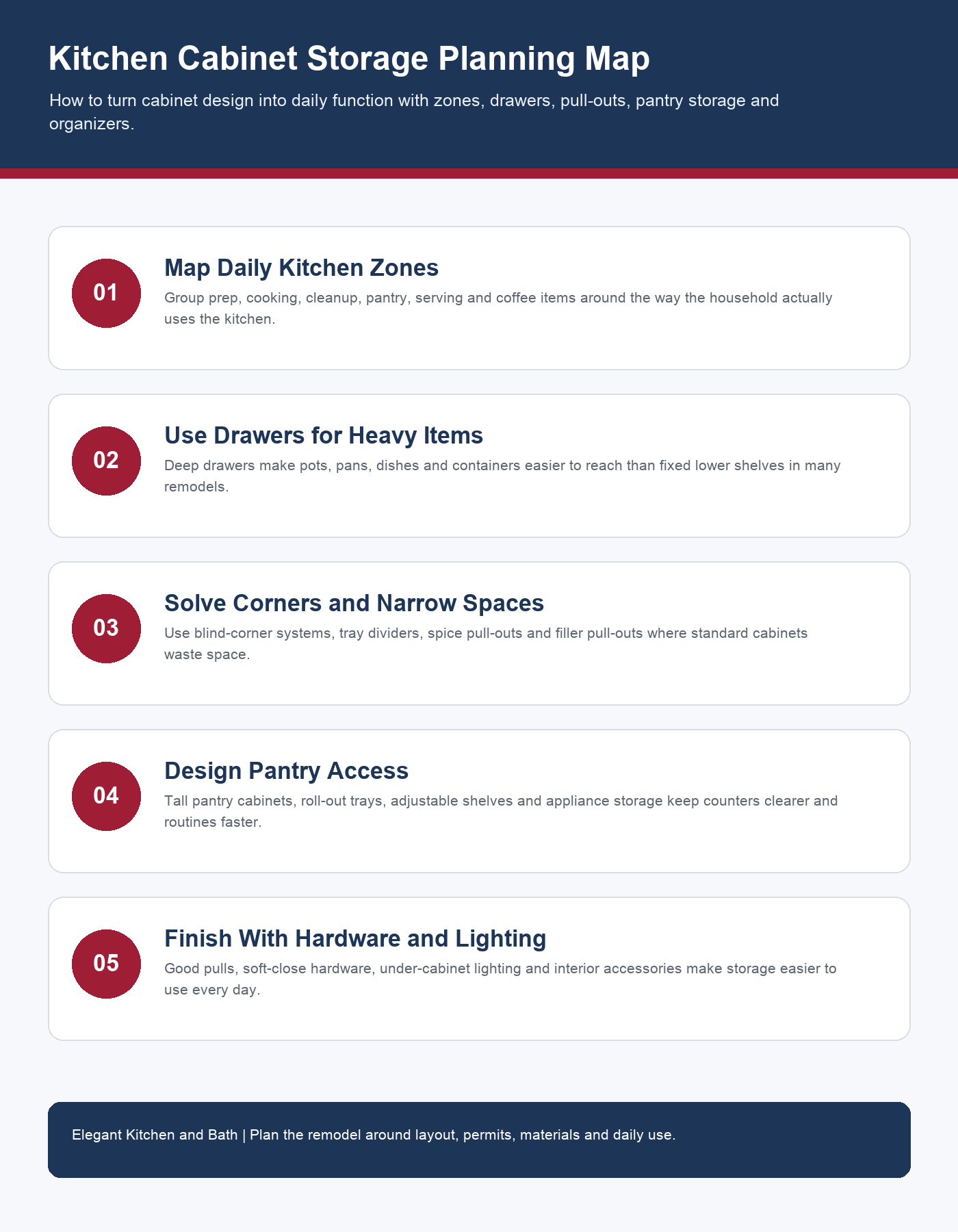
The second step is zoning. A kitchen needs prep, cooking, cleanup, pantry, serving and utility zones. Each zone should have storage that supports the task. For example, knives, cutting boards and mixing bowls belong near prep space. Pots, pans, oils and utensils belong near the cooking area. Plates and containers may belong near the dishwasher. Coffee supplies may deserve their own cabinet or drawer. When zones are clear, daily movement becomes easier.
Kitchen Cabinet Storage Options Compared
| Storage idea | Best use | Why it works | Planning note |
|---|---|---|---|
| Deep drawer bases | Pots, pans, dishes, bowls and containers | Drawers bring heavy items forward instead of hiding them on fixed shelves | Add peg systems or dividers to prevent sliding. |
| Pull-out trays | Lower cabinets, pantry cabinets and appliance storage | They improve access to items stored in the back | Check door clearance and hardware quality. |
| Trash and recycling pull-out | Cleanup zone near sink or prep area | Keeps bins hidden and clears floor space | Place near prep and dishwasher when possible. |
| Vertical tray dividers | Sheet pans, cutting boards, lids and serving trays | Flat items stay upright and easy to grab | Works well near ovens and prep zones. |
| Tall pantry cabinet | Dry goods, snacks, baking items and small appliances | Creates high-capacity storage in a compact footprint | Roll-outs make tall cabinets more usable. |
| Blind-corner organizer | Hard-to-reach corner cabinets | Turns corner space into accessible storage | Measure carefully before selecting a system. |
| Spice pull-out | Cooking zone beside range or prep area | Keeps oils, spices and small bottles organized | Avoid heat-sensitive storage directly beside very hot appliances. |
Deep Drawers: The Storage Upgrade Many Kitchens Need
Deep drawers are one of the most useful kitchen cabinet storage upgrades. Traditional lower cabinets with doors can hold a lot, but they often require bending, reaching and moving items out of the way. A deep drawer brings everything forward. Pots, pans, bowls, dishes, food containers and even small appliances can be easier to reach in drawers than on fixed shelves.
The key is organization inside the drawer. A deep drawer without dividers can become a heavy junk drawer. Peg systems can hold plates and bowls. Adjustable dividers can separate containers and lids. A dedicated pot-and-pan drawer can keep cookware near the range. A drawer near the dishwasher can make unloading faster. The best drawer is not just deep; it is assigned to a specific routine.
Drawer hardware matters. Soft-close glides, weight capacity and construction quality affect long-term performance. Heavy cookware can strain weak hardware. If the remodel includes premium countertops and appliances, the cabinet interiors should be built to match the level of use. Storage is touched every day, so durability is not optional.
Pull-Out Shelves and Roll-Out Trays
Pull-out shelves are especially useful when homeowners like the look of doors but want better access inside the cabinet. They can be installed in lower cabinets, tall pantry cabinets and some specialty storage areas. Instead of crouching to find a pot in the back, the homeowner slides the tray forward. This makes storage easier for busy families, older homeowners and anyone who wants less bending.
Roll-out trays are also valuable in pantry cabinets. Dry goods can get lost on deep shelves. A roll-out brings cans, jars, snacks and baking items into view. The best pantry roll-outs are not too tall; if items are stacked too high, the tray becomes messy. Shorter, category-based roll-outs are easier to maintain.
Not every cabinet needs a pull-out. Some items store well on standard shelves, especially larger or less frequently used pieces. The goal is to use pull-outs where access matters most. A good designer will ask which cabinets frustrate the homeowner now and then solve those specific pain points.
Pantry Cabinets: Tall, Narrow and Highly Organized
A walk-in pantry is not always possible, especially in older Northern Virginia homes. A tall pantry cabinet can still create excellent storage when planned well. The interior is the difference. Fixed shelves can work, but roll-outs, adjustable shelves and divided zones usually perform better. A pantry cabinet can hold food, snacks, small appliances, baking items, paper goods and overflow storage.
Pantry storage should follow shopping habits. A household that buys bulk items needs different storage than a household that shops every few days. Families with children may need snack drawers at reachable heights. A homeowner who bakes may need flour, sugar, pans and mixing tools in one zone. A coffee-focused household may need a beverage station near mugs, filters and sweeteners.
Tall pantry cabinets also need good lighting and hardware. A dark pantry becomes disorganized quickly. Interior lighting, nearby task lighting or a lighter cabinet interior can help. Door swing should be checked so the pantry does not block a walkway or collide with an island.
Pantry Planning Table
| Pantry category | Best cabinet feature | Design tip |
|---|---|---|
| Everyday dry goods | Roll-out trays or shallow adjustable shelves | Keep frequently used items between waist and eye level. |
| Snacks and lunch items | Lower drawers or pull-outs | Make them easy to reach without disrupting cooking zones. |
| Baking supplies | Grouped shelves with containers and tray dividers | Store measuring tools, mixers and pans nearby. |
| Small appliances | Deep roll-outs or appliance garage | Plan outlet needs if appliances will be used inside a cabinet area. |
| Bulk storage | Tall shelves or less accessible upper storage | Use upper zones for overflow, not everyday items. |
| Cleaning overflow | Separate cabinet away from food when possible | Avoid mixing chemicals with pantry items. |
Corner Cabinets: Stop Wasting the Hardest Space
Corners are where many kitchens lose storage. A basic blind corner can become a dark cave. Items disappear, and the homeowner stops using the space well. Modern corner solutions can help: lazy susans, blind-corner pull-outs, magic corner systems, kidney shelves or drawers designed for corner access. The right choice depends on cabinet dimensions and adjacent door clearances.
A corner system should be selected during design, not after installation. These accessories need specific cabinet sizes and opening widths. If a range, dishwasher or refrigerator handle is too close, the accessory may not function properly. Measurements matter, and the cabinet line must support the chosen solution.
Sometimes the best solution is not to force storage into a bad corner. A designer may choose drawers on one side and a more useful cabinet on the other, or shift the layout to reduce dead space. The goal is not to use every cubic inch; it is to create storage that the homeowner will actually use.
Vertical Dividers for Trays, Boards and Lids
Flat items are hard to store when they are stacked. Cutting boards, sheet pans, cooling racks, muffin tins, serving trays and pot lids become frustrating when the homeowner has to remove five items to get one. Vertical dividers solve this. They turn narrow spaces into organized storage and work especially well near the oven, range or prep area.
Vertical storage can be built into a base cabinet, tall pantry, island end or upper cabinet. It can also be used for lids if cookware is stored in deep drawers. The key is location. Sheet pans should live near the oven. Cutting boards should live near prep space. Serving trays can live closer to dining or island storage.
This is a small upgrade with a big daily payoff. It does not require a large footprint, but it prevents one of the most common kitchen annoyances: the collapsing stack of flat items.
Trash, Recycling and Cleanup Storage
Trash and recycling pull-outs are now expected in many kitchen remodels. They keep bins off the floor and support a cleaner workflow. The best location is usually near the sink, dishwasher and prep area. If the kitchen has a large island where most prep happens, a trash pull-out in the island may be more useful than one at the perimeter.
Cleanup storage should include more than trash. Dish soap, dishwasher pods, sponges, towels, cleaning sprays and extra bags all need a home. Sink-base organizers can help use the awkward space around plumbing. A tilt-out tray may hold small cleaning tools. A pull-out under the sink can keep supplies from becoming a messy pile.
For families, cleanup storage should be intuitive. If the trash pull-out is too far from prep, scraps end up on the counter. If towels are not near the sink, they migrate to appliance handles. If cleaning supplies are hard to reach, the area under the sink becomes chaotic. Good storage reduces these tiny daily frictions.
Appliance Garages and Countertop Clutter
Small appliances are one of the biggest causes of countertop clutter. Coffee makers, toasters, blenders, mixers, air fryers and pressure cookers all need space. Some deserve permanent counter locations. Others should be stored but easy to access. Appliance garages, deep drawers and pantry roll-outs can help keep counters clearer.
An appliance garage should be planned with electrical needs and ventilation in mind. If the homeowner wants to use an appliance inside the garage, outlets and heat clearance matter. If the garage is only for storage, the door style and depth are the main concerns. Tambour doors, lift-up doors and pocket doors can all work depending on the design.
A coffee station is another strong storage idea. Mugs, filters, beans, sweeteners and small spoons can live together. If the station is near water or the refrigerator, the routine becomes easier. These lifestyle details make a remodel feel custom because the kitchen supports habits instead of forcing the homeowner to adapt.
Island Storage Ideas
Kitchen islands can add valuable storage, but only when designed intentionally. An island can hold deep drawers, a microwave drawer, tray dividers, trash pull-outs, serving storage, cookbooks, outlets, seating support or a beverage zone. It should not become an oversized block that interrupts movement. Walkway clearance is just as important as storage capacity.
If the island is the main prep area, it should hold prep tools. Cutting boards, mixing bowls, knives, trash and towels may belong there. If the island is mainly for serving and entertaining, drawers for plates, napkins, serving utensils and chargers may make more sense. If children use the island for homework, charging and school supplies may need a nearby drawer.
Island end panels can also become storage. Narrow shelves, tray storage or display areas may work, but they should not create clutter. The best island storage looks integrated and supports the kitchen’s main purpose.
Cabinet Accessories Worth Considering
- Spice pull-outs near the range or prep area
- Knife drawer inserts for safer storage
- Peg systems for plate and bowl drawers
- Mixer lift shelves for heavy stand mixers
- Drawer dividers for utensils and cooking tools
- Roll-out shelves for pantry and lower cabinets
- Tray dividers for sheet pans and cutting boards
- Pull-out towel storage near the sink
- Charging drawers for devices and small electronics
- Under-sink organizers around plumbing
How to Avoid Over-Organizing
There is such a thing as too many accessories. A kitchen can become expensive and overly specific if every cabinet is assigned a specialty insert. The best plan balances flexibility with function. Some drawers should be highly organized. Others should be adaptable. Adjustable dividers and roll-outs often age better than fixed inserts that only fit one item.
Homeowners should prioritize daily pain points. If pots are hard to reach, solve cookware storage. If pantry items are chaotic, improve pantry access. If counters are crowded, plan appliance storage. If the trash is in the way, add a pull-out. Storage upgrades should solve real problems rather than fill a checklist.
Future flexibility matters too. Families change. Cooking habits change. Appliances change. A good cabinet plan should work today and still make sense several years from now. That is why adjustable interiors, quality hardware and clear zones are often more valuable than trendy accessories.
Storage Ideas by Kitchen Type
A compact kitchen needs storage that creates calm. Deep drawers, vertical dividers, a narrow pantry pull-out and a hidden trash solution can make a small footprint feel more capable. Light finishes and fewer counter items help the room feel larger. In a compact kitchen, every cabinet should earn its place.
A family kitchen needs durable, easy-to-reset storage. Snack drawers, lunch storage, dish drawers near the dishwasher, trash near prep and a strong pantry plan can reduce daily stress. Children can help more when storage is reachable and intuitive. The kitchen stays cleaner when the system is easy to follow.
A luxury kitchen needs storage that disappears into the design. Appliance garages, paneled pantry cabinets, integrated lighting, custom inserts and wide drawer banks can support a refined look. The goal is not to show every organizer. The goal is to make the kitchen feel effortless.
An entertainer’s kitchen needs serving and beverage storage. Glassware, trays, bar tools, napkins, serving utensils and beverage appliances should be easy to access without crowding the cooking zone. A secondary pantry, butler’s pantry or beverage cabinet can be useful if space allows.
How Cabinet Storage Connects With Countertops and Lighting
Storage planning affects countertop use. When appliances and daily items have homes, the countertop can stay clearer. That makes the countertop material more visible and easier to maintain. A quartz or granite surface looks better when it is not covered with mail, small appliances and pantry overflow.
Lighting also supports storage. Under-cabinet lighting helps prep areas. Interior cabinet lighting can help tall pantry storage. Drawer lighting may be useful in premium designs. Even simple task lighting makes it easier to use the storage plan. A dark kitchen often feels more cluttered because items are harder to see.
Hardware is the final touch. Pull size, finish and placement affect comfort. Large drawers need pulls that feel good in the hand. Tall pantry doors need hardware that supports the scale. A beautiful cabinet design can feel awkward if hardware is undersized or poorly located.
How Elegant Kitchen and Bath Plans Cabinet Storage
Elegant Kitchen and Bath helps homeowners think beyond cabinet color. A strong kitchen remodel connects layout, storage zones, cabinet construction, countertop selections, lighting, hardware and installation. The design process should ask how the household cooks, shops, cleans, entertains and stores everyday items. That information leads to a better cabinet plan.
If you are planning a kitchen remodel, review Elegant Kitchen and Bath’s kitchen remodeling services, cabinet products, countertop services, quartz countertops, project gallery and appointment page. These links help homeowners move from ideas to a real design conversation.
Cabinet Storage Planning Checklist
- List the items that frustrate you in the current kitchen.
- Decide which appliances stay on the counter and which need hidden storage.
- Group items by prep, cooking, cleanup, pantry, serving and coffee zones.
- Use drawers for heavy everyday items when possible.
- Plan trash and recycling near the main prep or cleanup area.
- Add vertical dividers for trays, boards and lids.
- Choose pantry interiors based on shopping and cooking habits.
- Measure corner cabinet clearances before selecting accessories.
- Coordinate storage with lighting, outlets and countertop space.
- Leave some flexible storage for future changes.
Frequently Asked Questions
What kitchen cabinet storage upgrade is most useful?
Deep drawer bases, pull-out trays, pantry roll-outs, trash pull-outs and vertical dividers are among the most useful upgrades because they make everyday items easier to see, reach and put away.
Are pull-out shelves worth it in a kitchen remodel?
Pull-out shelves are often worth it for lower cabinets and pantry cabinets because they reduce bending, prevent items from getting lost in the back and improve daily access.
How do I plan pantry storage in a cabinet remodel?
Start by grouping food, small appliances, snacks, baking items and bulk goods. Then choose tall pantry cabinets, roll-outs, adjustable shelves or drawer storage based on how the household cooks and shops.
Should I choose more cabinets or better cabinet organizers?
Better organizers often matter more than simply adding cabinets. A well-designed drawer, pull-out or pantry can store more usable items than a larger cabinet with poor access.
Final Thoughts
Kitchen cabinet storage ideas are most powerful when they are planned as part of the remodel, not treated as extras. Pull-outs, pantry cabinets, deep drawers, corner solutions, trash storage, appliance garages and organizers can make the kitchen easier to use every day. The right storage plan reduces clutter, protects the investment in new cabinets and countertops, and makes the remodel feel truly custom.